Rolling Luggage Range Overview
CHUBONT's rolling luggage range is the part of our catalogue built around wheels and handles: 16, 20, 24 and 28 inch cases, three-piece sets and wheeled travel bags that share the same running gear. Hard-shell and soft constructions sit side by side in it, so a buyer can hold one price band together without splitting the order across three suppliers.
We have worked as a luggage bags manufacturer since 1998, running two factories in Guangdong, with more than 30 years of luggage and bag expertise behind the patterns, materials and hardware. The cases, sets and wheeled duffels in this range come out of those workshops rather than being bought in and relabelled.
Buyers come to the range for three different jobs. A distributor restocking a mid-market shelf needs a size ladder, a colour story and a quality standard that repeats. A brand owner wants the same case with their own logo, lining and packaging, then a second run that matches the first. A corporate or institutional buyer is allocating rather than selling — one carry on luggage piece per traveller, one wheeled bag per crew member, delivered to a schedule.
What the range replaces is the mixed sourcing most buyers start with: one factory for hard cases, another for soft bags, a third for a rolling travel bag line, and no shared colour or hardware reference between them. Because everything here is made in the same workshops, a single order can carry one colour story, one zip specification and one packing standard from the smallest cabin case to the largest checked case.
Start with the sizes and constructions that match your price band, settle the customisation route for logos and packaging, then build the first order from the models listed below.

Wheel, Handle and Zip Construction
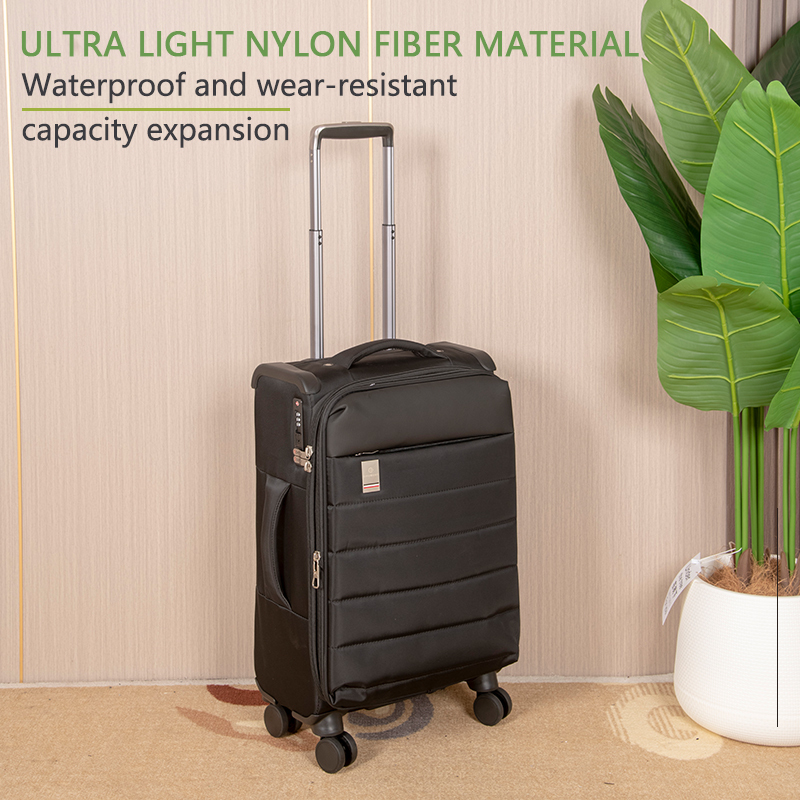
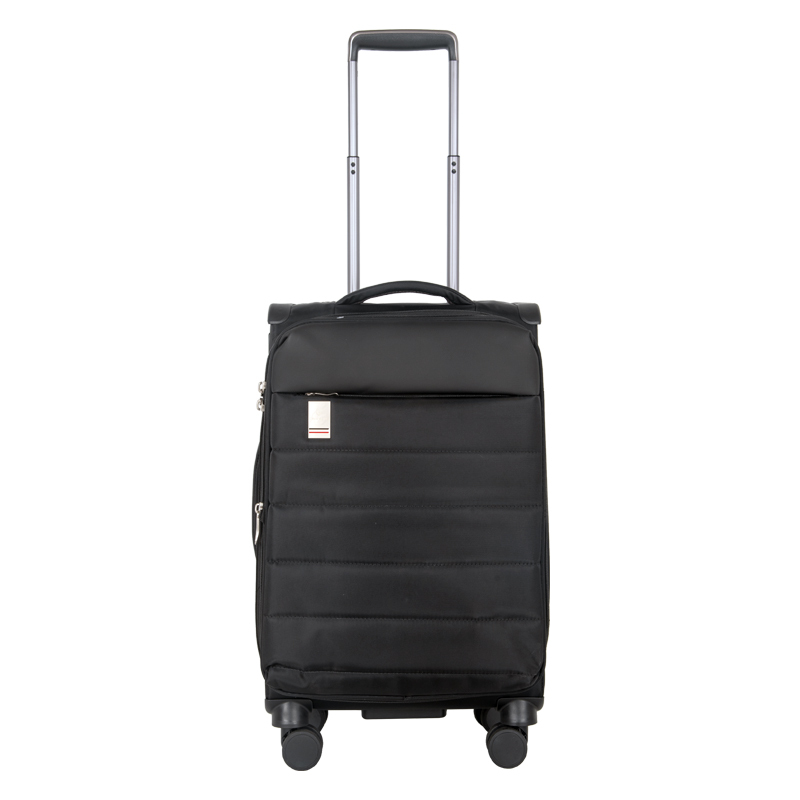
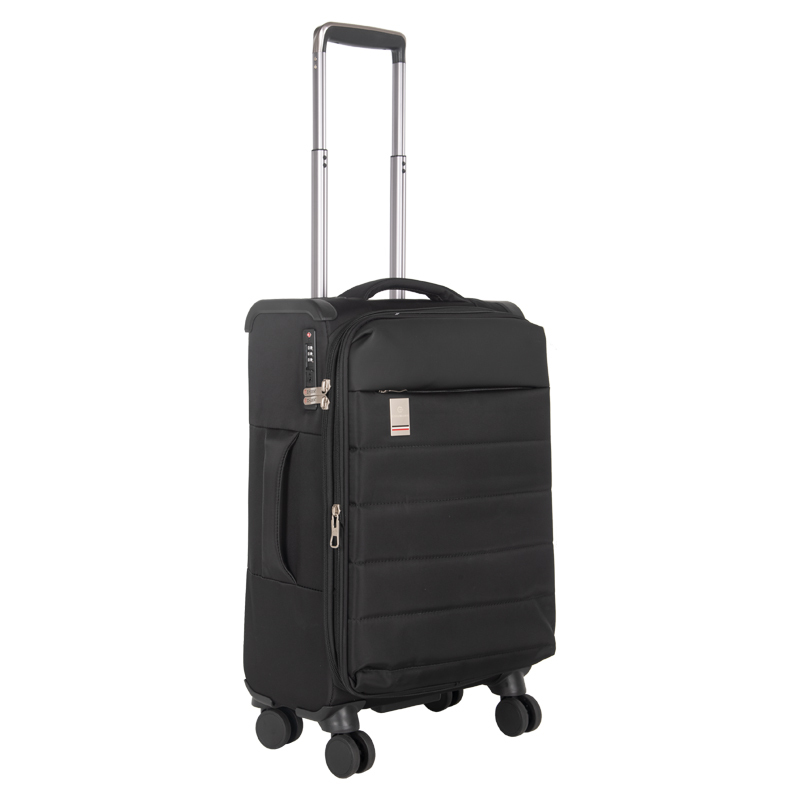
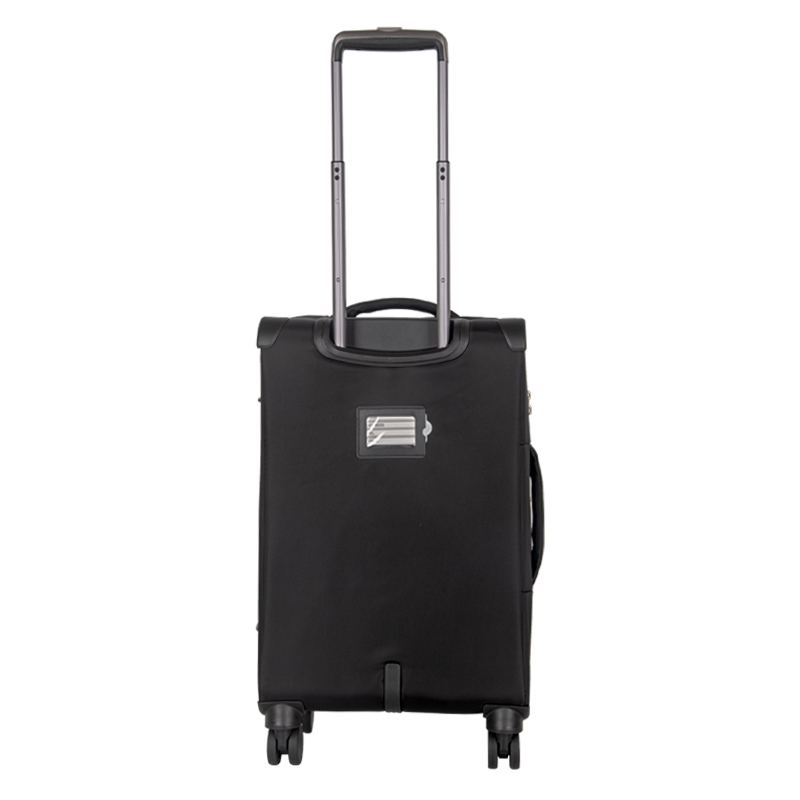
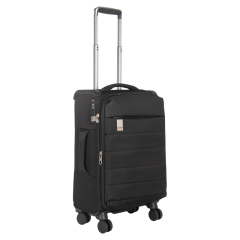
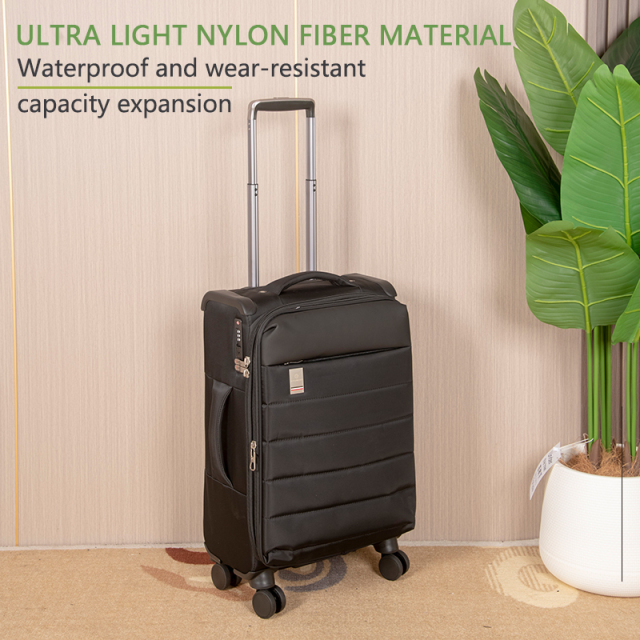
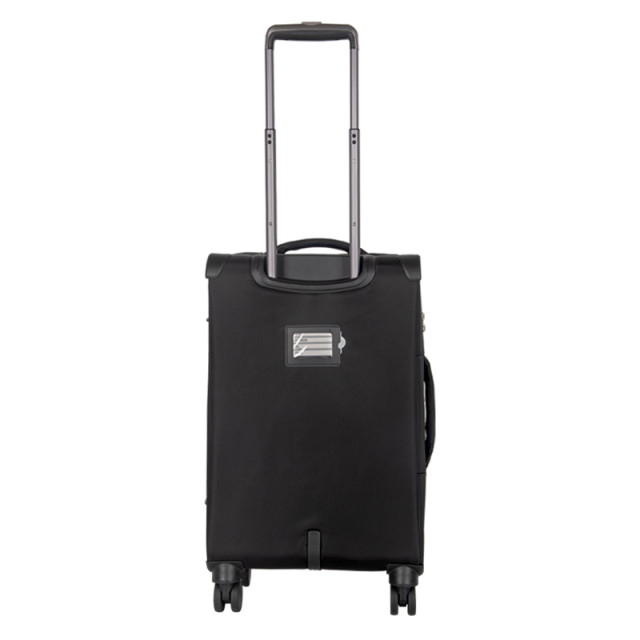
Four casters sit under each case, mounted independently so every wheel swivels on its own axis. That is what lets a loaded case move sideways along a check-in queue, turn in place at the end of a hotel corridor, or roll diagonally around a pillar instead of being dragged. Independence also spreads the load: a case pulled on two wheels puts its weight through one axle, while a case pushed on four shares it.
On any spinner luggage the casters are the first parts to show wear, which is why we keep wheel assemblies serviceable and ask buyers to confirm spare sets with their sales contact when the order is placed. A wheel should never be the reason an otherwise sound case is retired.
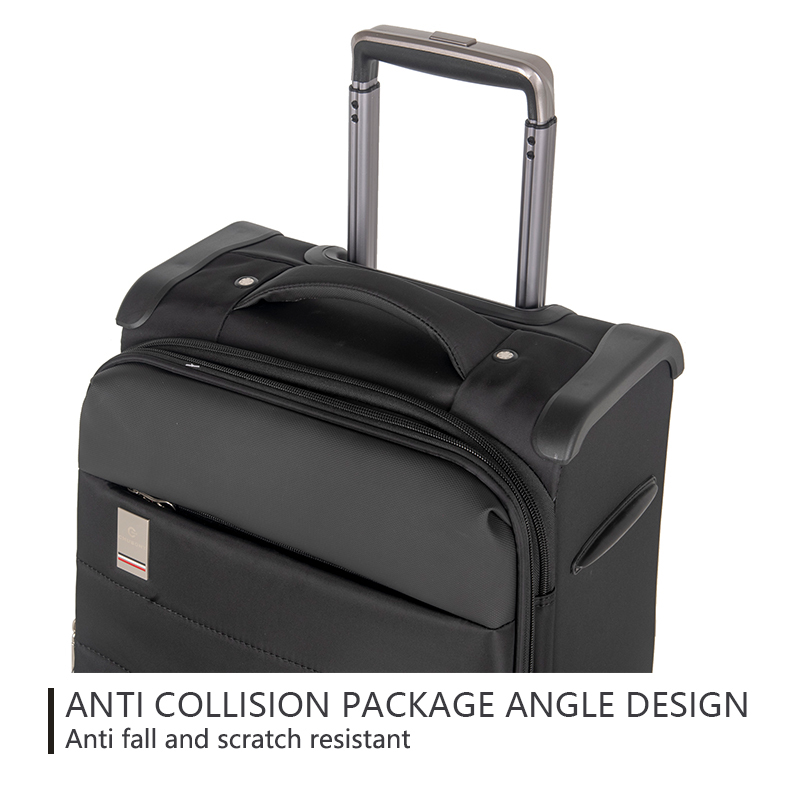
Above the case, the handle is aluminium and multi-position, locking at several heights so it can be set for a tall user or a short one. On the sample, push the handle down under load and check the play at full extension: a little movement is normal in a telescopic tube, a loose rattle is not.
Soft cases carry reinforced anti-collision corners at the points that meet a baggage belt first. On softside luggage the corner guards take the scuffing so the main body does not, and they are one of the cheapest places to specify a heavier material.
Zips are high-strength, with pulls sized to be gripped by a gloved hand. On a soft case or a rolling travel bag, the zip and its stitching are the structural seam — everything else hangs off that line — so the zip specification and the stitch density are worth agreeing before production rather than after it.
Shells and side panels are built to absorb impact rather than pass it on: hard shells flex and return, soft cases rely on padding and frame. Neither should be sold to a buyer as indestructible. Both should be checked against how the case will actually be handled in the destination market.
Carry On and Checked Sizes
- 16 inch — cabin size for short trips. Built around one to three days of travel for one person, and the size crews and commuters reach for because it goes straight into the cabin as carry on luggage. Carrier limits differ, so check the outer dimensions, wheels and handle included, against the airlines your customers actually fly.
- 20 inch — the size that needs a decision. Some carriers take a 20 inch case into the cabin and others count it as checked baggage. Settle that before any finished packaging carries a cabin claim, and keep the measured outer dimensions ready for buyers who have to check it against their own travel policy.
- 24 inch — a week for one person, a few days for two. The middle checked size suits short overseas trips, site visits and family weekends, and it is the volume seller in most softside luggage ladders.
- 28 inch — long trips and family loads. The largest checked case here, used for two-week journeys, multi-person family travel and anything that comes home heavier than it left.
- Sets — 20/24/28 and 20/24. Sets lift the average order value and give a customer a case for every trip length, but they complicate replenishment: if one size sells out first, the other two sit. Many buyers display sets and restock with singles.
- How to measure. Quote the outside dimensions with wheels and top handle included, because that is what a carrier measures and what a store shelf has to hold. Loading capacity moves with clothing thickness and packing style, so treat any litre figure as a planning guide rather than a promise.
Business Travel Scenarios
- Airport terminals and security lanes. A traveller crosses a terminal, a train, a bus and a hotel lobby in a single day, and the case has to keep pace — start, stop, turn and start again without being lifted. Cases that are pushed on four wheels rather than dragged on two are also the ones that come back from a trip looking new.
- Rail stations, metro platforms and hotel corridors. Narrow platform edges, lift thresholds, carpet and tile changes are where a binding wheel turns into a complaint. Rolling luggage that tracks straight on a smooth floor also has to cross a threshold without tipping.
- Long-haul checked travel. Belts, holds, transfer carts and stacking. A checked case is handled more on a single trip than a cabin case is in a year, which is why corners, zips and shells deserve the specification budget ahead of the fabric print.
- Corporate allocation and crew issue. Travellers, flight crew and field teams each get one case in one colour with one company mark, often ordered as a wholesale rolling travel bag line for crews who need a soft, expandable shape rather than a hard shell. Sizing, colour and marking have to be identical across the batch so nobody receives a mismatched piece.
- Store shelves and marketplace fulfilment. A spinner luggage set merchandises well on a shop floor. Softside luggage packs flatter into a carton and travels better through a parcel network when it is boxed rather than cased. Most ranges sell both formats side by side.
- Institutional and project supply. Hotels, transport operators and training establishments replace bags on a cycle rather than a season, so they need a model that will still be available at the next replacement round.
Featured Models
| Model |
Size |
Key details |
| LB-101087 |
16 in |
Unisex cabin case with 360° spinner wheels |
| LB-101171 |
20 in / 24 in |
Waterproof spinner set, high-capacity checked cases, TSA lock |
| LB-101157 |
28 in |
Ultralight business case, shock-resistant, high capacity, 360° wheels |
| LB-101156 |
20 in |
Nylon spinner, lightweight build, 360° wheels, reinforced corners |
| LB-101137 |
20 in / 24 in / 28 in |
Three-piece set, durable checked cases, TSA lock, shock-resistant |
| LB-101136 |
Large |
PU leather, vintage geometric panel, high-capacity spinner |
| LB-101153 |
Rolling travel bag |
Waterproof, multi-compartment, expandable, business carry-on |
| LB-101066 |
Foldable duffel |
Large capacity, lightweight, waterproof, folds flat |
Custom Carry On Development
- Send the brief. Put the model reference, the sizes you want, quantities, your logo plan, colour direction, lining, packaging and destination market in one message. For a custom carry on luggage programme, the logo artwork and the target price point are the two details that shape everything else.
- Review material and structure options. We come back with the material choices that fit, any structure changes your idea needs, and what each option does to the unit cost.
- Approve a sample. A physical sample lets you hold the colour, check the logo position and pull the zip under load. Compare it against the brief, not against a photograph.
- Confirm in writing. Material, colour, size, logo, construction and packaging are signed off in a written specification so the production floor and the buyer are working from the same document.
- Produce. The order is scheduled in our own workshops, with the confirmed sample kept as the reference for the line.
- Repeat runs. The specification file stays with the account, so a reorder picks up the same zip, wheel, colour reference and packaging without rebuilding the brief from memory.
Design Notes on Customisation
Our design team spends most of its time on the least glamorous part of customisation: how far one pattern can flex before it has to become a new pattern. Colour, lining, logo plate, zip puller and packaging can all change on a standard body. Change the shell depth or the wheel base and the tooling changes with it, and so does the price. Knowing where that line sits is what lets a smaller brand order something that looks bespoke without paying for a new mould.
Smart features come up in almost every development conversation — tracking tags, app-connected locks, a battery pocket in the cabin case. Some of them earn their place in a wholesale range; others add cost, weight and a support burden the wholesale order never recovers. We test each idea against a simple question: would a traveller notice this on the second trip as well as the first?
Responsible manufacturing, for a luggage bags manufacturer, is mostly a question of durability. A case that lasts six years instead of two consumes far less material over the same period, and replaceable wheels and handles are worth more to a buyer than an unverified green line on a hangtag. That is the direction we build in: fewer parts that fail, more parts that can be replaced.
Wholesale Program Planning
The first decision is the shape of the ladder: how much of the order sits in cabin sizes and how much in checked. Markets built on short business trips and dense rail networks carry a heavier 16 and 20 inch mix, while holiday-led markets want 24 and 28 inch volume. Get that ratio wrong and the rolling luggage sits in the warehouse while one size sells out twice.
Colour is the second decision. One core colour across the whole ladder keeps reorders simple and lets a stockist build a display from mixed stock, while a seasonal accent on spinner luggage sells the new season but has to be committed to in a quantity that will clear. Put the colour reference on the specification sheet as well as the purchase order, or the second run will drift.
Sets versus singles is a margin question. A 20/24/28 set lifts the average ticket, while singles keep stock simple and let a smaller stockist test the water. A wholesale rolling travel bag line reaches a different customer — crews, site teams and travellers who prefer an opening to a lid — and gives a range a second entrance.
Most buyers also want at least one custom carry on luggage programme: their logo on the cabin case that gets seen in airports, with a standard colour through the rest of the ladder. Build the logo case first and let the other sizes follow the same colour and hardware, so the range reads as one family rather than three separate purchases.
When you compare luggage bags manufacturer options, the questions that separate them are unglamorous. Can this exact zip, wheel and colour be remade next year? Will the specification file outlive the sales contact who wrote it? Is there an inspection record from the last run that a buyer can read? Those are the questions our account team expects, and they are the reason the same factories and the same specification files sit behind repeat orders.
One last check before the order closes: whether the ladder should exist in both a hard shell and a softside luggage build. Stockists who offer both hold more shelf space, and a factory that makes both can keep the colour and hardware aligned between them.
Ordering, Packing and Delivery
- Packing options. Basic packing is the standard for this range. Custom packing and the supporting materials that travel with the goods are agreed per order and quoted with it, so a buyer knows exactly what the carton contains before it ships.
- Carton marks and mixed loads. Carton marks carry the model, size and colour, which matters when a wholesale rolling travel bag order shares a container with case orders and the far end has to separate them without opening every box.
- Minimum order quantity. It moves with the model, the material, the number of colours and how much customisation is involved. Confirm the figure for your intended mix with your sales contact rather than assuming one number covers the whole range.
- Lead time. Production is scheduled once the sample and specification are signed off. Season, material availability and order size all affect the date, so ask for a written schedule alongside the confirmation.
- Contact. Reach the team at 3862084721@qq.com or +86-152 1880 3110, or write to Building 19, Wanyang Zhongchuang City, No. 12 Yingfu Industrial Park, Taiping Town, Qingxin District, Guangdong Province. Send the model reference, sizes, quantities and destination market with your enquiry and the reply will be specific.
Quality Control & Inspection
Every CHUBONT order passes five checkpoints inside our own workshops: incoming materials, pre-production samples, in-production patrols, finished-goods review, and a final pre-shipment check against the order. Batch records are kept, so buyers can see what was checked and when. You are welcome to send your own QC team, or appoint an independent inspector such as SGS or BV, to verify goods before they leave, and we support factory audits and on-site monitoring while production runs. Shipping marks, packing lists and carton labelling are confirmed against your instructions before loading.
FAQ
Do the cases have separate compartments inside?
Yes. The interiors are built in layers rather than one open cavity, with separate sections for documents, clothing and toiletries so a traveller can reach one thing without unpacking the rest. The layout differs between models — the sections in a 16 inch cabin case are shallower than those in a 28 inch checked case — so ask for the interior layout of the specific model you are considering.
What does a TSA lock on these cases actually do?
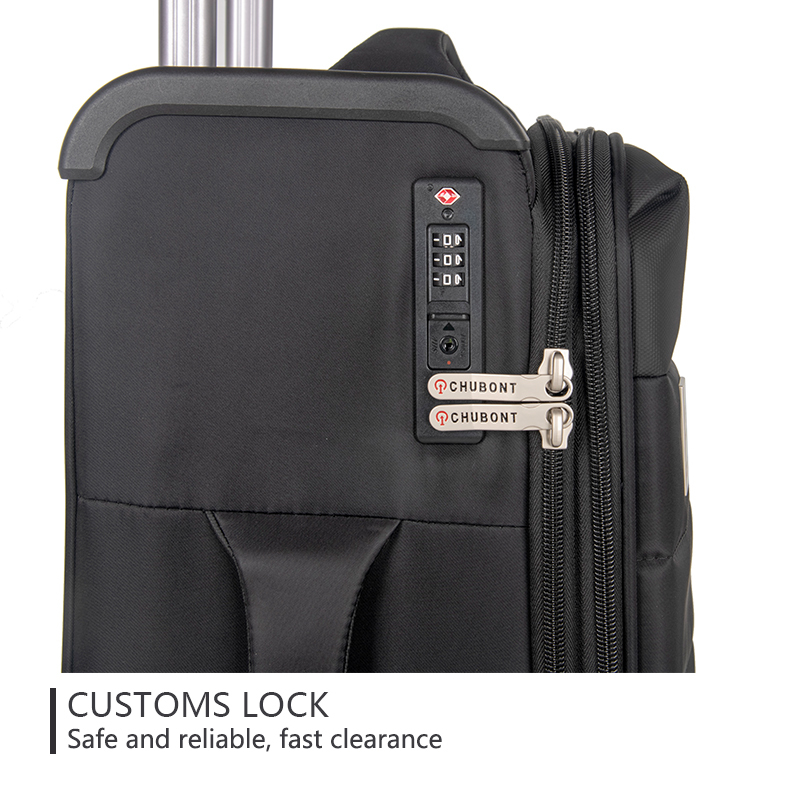
It lets airport security open the case, inspect it and re-lock it without cutting the zipper pulls or breaking the lock body. The lock is one component we specify per order, so if your market needs lock documentation for customs or commercial compliance, ask your sales contact for the specification that applies to the models you are buying.
Can I order one size instead of the full set?
Yes. A 20/24/28 set is three individual cases rather than a sealed unit, so a buyer can take a single size for restocking and take the set only for display. Tell us which sizes you plan to carry and we will quote them separately so the split is visible in the pricing.
What is the difference between the nylon, Oxford and PU cases?
Nylon cases are the lightest and the most forgiving of knocks, which suits cabin sizes and frequent short trips. Oxford is a firmer weave that holds a more structured shape on a softside body. PU leather gives the vintage geometric finish on the large model and wipes clean, at a little more weight. Choose by how the case will be sold — a lightweight cabin story, a structured business look, or a fashion-led floor piece.
Can the cases carry our logo and our own packaging?
Yes. A custom carry on luggage programme can carry your logo as a print or a plate, with the colour, lining, zipper pullers and packaging matched to it. Send the artwork and the target price point together, because the logo method and the packaging both move the unit cost and it is easier to choose between them when the price ceiling is known.
Will a 20 inch case be accepted as carry on luggage?
It depends on the airline and on the case's measured outer dimensions rather than on the nominal size. Tell us which carriers your customers fly and we will give you the outside measurements, wheels and handle included, so you can check them against each published limit before a cabin claim goes onto packaging.