Product Overview
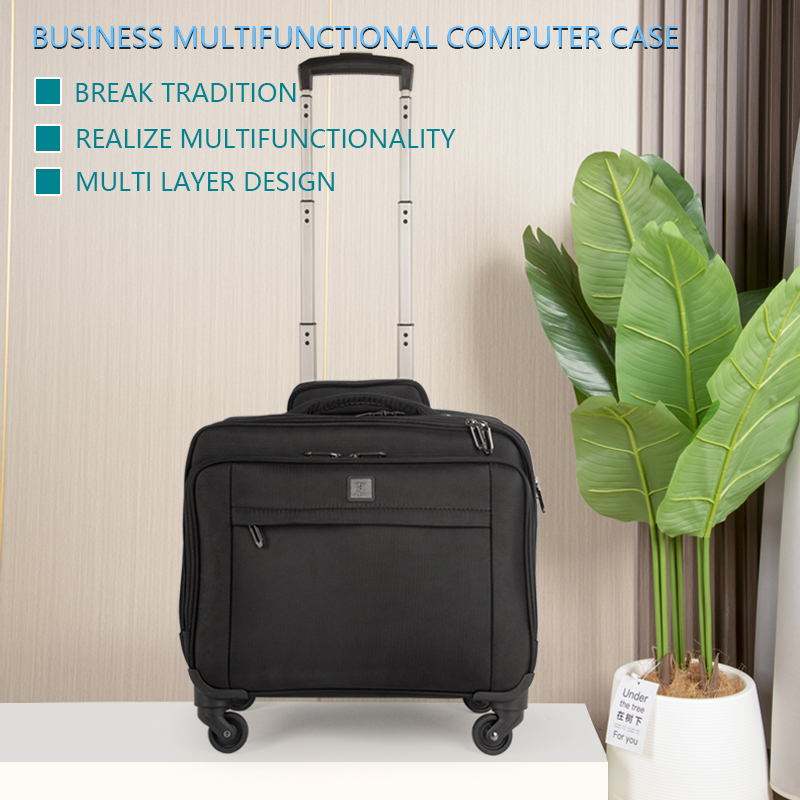
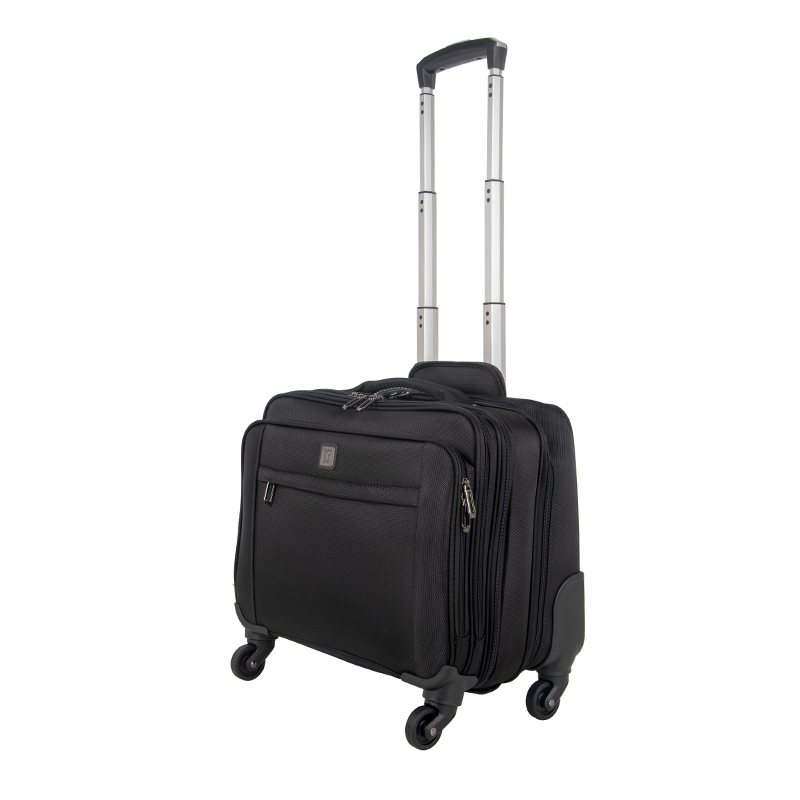
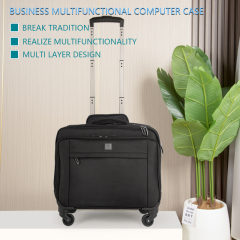
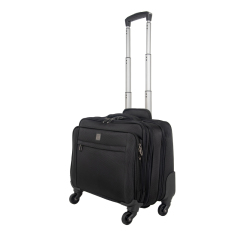
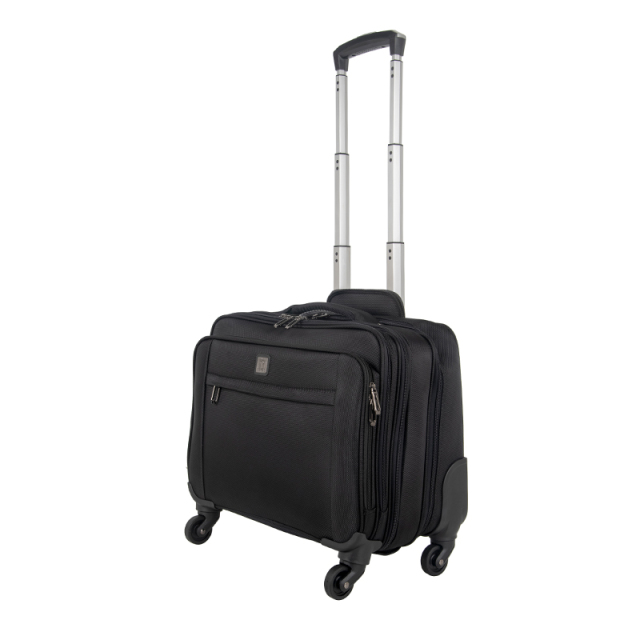
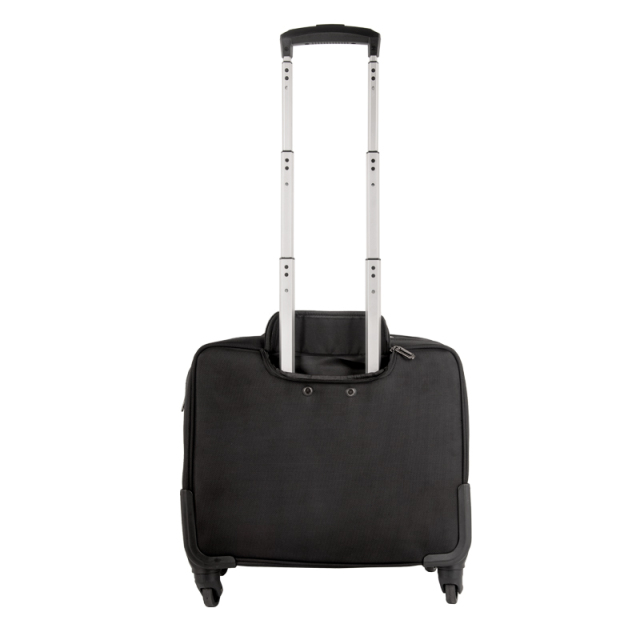
CHUBONT LB-101087 is a 16-inch upright cabin case built around the shortest trips on the calendar: one traveller, one to three days, no checked bag. Four 360° wheels carry a soft-sided body, the telescoping handle retracts flush into the back panel, and a detachable shoulder strap lets the case leave the floor when wheels are not the fastest option — a spinner carry on luggage design that still works at the bottom of a staircase. Inside, a padded compartment keeps a laptop and a folder apart from clothing, which is the practical reason most people stop carrying a second bag.
The format suits travellers who fly often and pack light: consultants, sales leads, executives on site visits, anyone whose week is a run of two-night stays. It is equally useful to a company issuing the same case to a whole team, and to a distributor who would rather range one dependable cabin model than five variations of the same idea. Because the case is small, it goes where a 20-inch carry on luggage becomes a negotiation — tight cabin limits on short-haul and low-cost carriers, crowded gate areas, and an overhead bin above a seat that is already half full.
Day to day it does quiet work. It goes into the cabin with the traveller, lives beside a hotel desk for two nights, and comes home without a detour past a baggage carousel. Nothing about it needs explaining to the person who receives it, which matters when you are handing out several hundred.
Material & Build
Fabric and lining
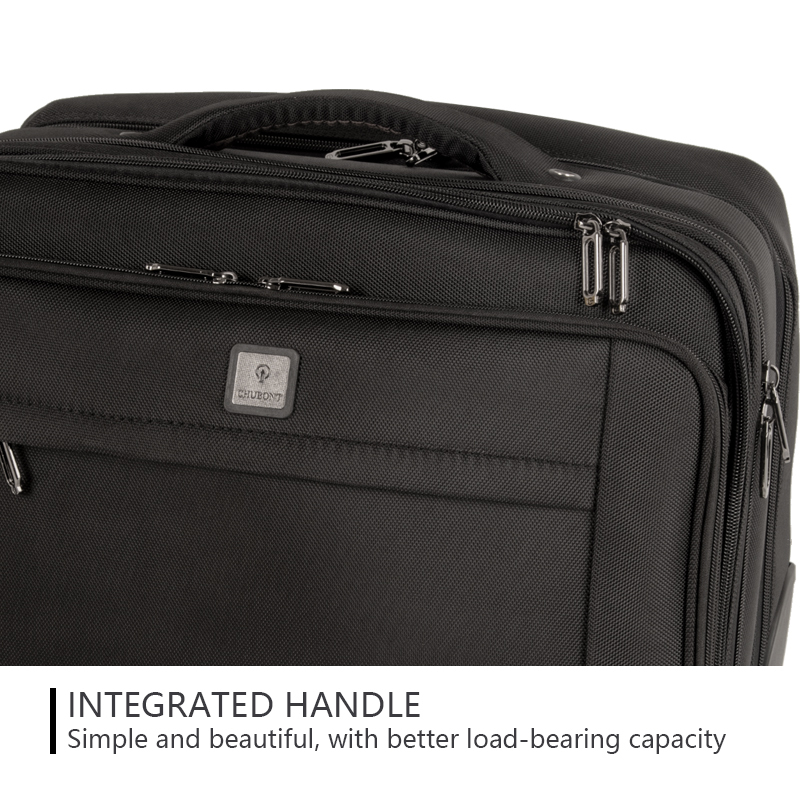
The body is a soft-sided woven fabric over a structured frame. Weave, backing and any surface treatment are three separate lines on the order, because a carry on luggage case is judged on all three: the weave sets how the body drapes and how it takes a knock, the backing stiffens it, and the treatment decides how it copes with rain and how easily it wipes clean. The lining is a lighter, smoother cloth so clothing slides in and out instead of catching on seams. Hardware and trim The castors, the telescoping handle, the top handle, the zip and the strap clips each carry their own specified finish, and all of them are on the outside of the case — the parts a customer touches first. Hardware is agreed alongside the fabric in the same document, so a later change of castor or handle colour does not leave a batch mismatched. Tell us if your market prefers a particular metal tone, or a matte rather than a polished fitting. Signing off the specification Before mass production we put your order on paper: fabric and lining, colour standard, castors and handle, zip, logo and its placement, packing. That specification is matched to a sample you approve, and production is measured against the approved sample rather than against a catalogue photo. If your market needs a defined fabric weight, a particular coating or a specific fitting, raise it at the enquiry stage — settling the detail once is faster than correcting a shipment, and it is the part of a wholesale luggage order that most often causes trouble later. - Reinforced where a case actually fails — The base seam, the handle mounts and the wheel housings are the three points that end a bag's working life. Each is reinforced and stitched rather than spot-fixed, so the case keeps its shape through daily handling instead of softening at the corners after a few months. - A closure line that stays shut — The zip runs in a closed line around the case, with pullers that tuck flat. Nothing loops out to catch on a belt, a bin edge or another bag, and the case does not gape open when it is pressed into a full overhead bin. - Structure that shields the device inside — The padded compartment sits against the back panel, the stiffest part of the shell. A soft-sided body absorbs a knock instead of passing it straight through to a laptop the way a rigid shell can, and the frame stops the case folding in on itself when it is full. - One standard across the fleet — A carry on suitcase with wheels is only useful to a programme if unit two hundred behaves like unit one. Every case leaves with the same handle height, the same four-wheel base and the same internal layout, so what one traveller learns applies to everyone you equip, spares stay simple, and replacing a single unit does not create an odd one out. - Ready to carry a house brand — For a business travel luggage programme, the case is a moving piece of the brand.
16-Inch Cabin Format
The working cycle is one person, one to three days: a domestic short-haul business trip, a site visit, a two-night conference, an overnight in another city. That is the trip this model was dimensioned for, and it is why the load stays short — a change of clothes, a laptop, documents, toiletries, a charger, ID. Business travel luggage sized for a two-night trip is faster at every point in the trip, because the traveller never queues at a bag drop, never waits at a carousel, and never has to explain a damaged case to an airline.
Where it earns its place is the awkward middle of the trip. It turns inside a narrow cabin aisle, fits an overhead bin that a 20-inch case would fill, and moves from terminal to taxi to office to hotel without being set down and repacked. On low-cost and short-haul international carriers, where cabin limits are enforced at the gate with a measuring frame, the smaller format reduces the chance of being asked to check the bag at the worst possible moment.
A 20-inch case gives one traveller noticeably more volume; 16 inches trades that volume for certainty at the gate. For a wholesale luggage range, that makes it the cabin option a custom luggage manufacturer builds to sit alongside 20-, 24- and 28-inch models rather than instead of them.
Airline rules are not uniform. Carry-on dimensions and weight limits differ between full-service carriers, low-cost carriers and individual routes, so check the rule for the specific airline and fare before you commit. Final acceptance is always the airline's decision, and packing changes the outside dimensions slightly — treat the format as guidance, not a guarantee.
Short-Trip Packing Guide
- Plan the trip, not the wardrobe. A business travel luggage case for one to three days carries two changes of clothing, one pair of shoes, a toiletries pouch and the work kit. Build the list around that and the case closes comfortably.
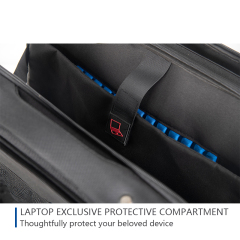
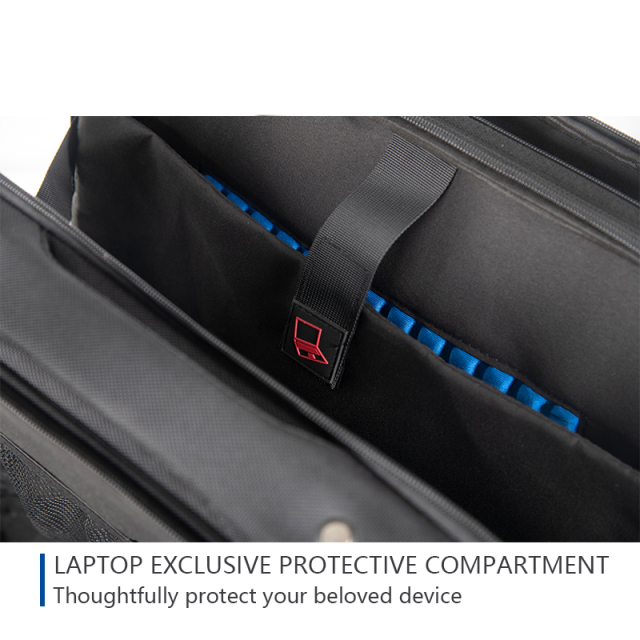
- Load the device end first. A laptop and a folder go into the padded compartment against the back panel, where the frame gives them something solid to sit against.
- Roll the clothing. Rolled shirts and trousers fill the main compartment with fewer creases than folded stacks, and they press into the gaps around the frame instead of leaving dead space.
- Put shoes and heavy items near the wheels. Weight kept low and close to the castor end keeps this lightweight spinner carry on luggage steady when it is pushed, and stops it tipping when it is stood up.
- Keep a quick-access layer. Charger, passport, liquids and boarding pass belong where you can reach them without opening the main compartment in a security queue.
- Leave a little slack. A case packed solid is hard to close, strains the zip and has no room for anything picked up on the way. Two fingers of space across the top is enough.
- Reset it between trips. Empty the pockets, wipe the inside, and leave the case open overnight so the fabric and lining dry out before it goes back into a cupboard.
Spinner Wheel System
- Four wheels, all on the floor — With the handle extended, every castor stays down and the case can be pushed forward, pulled behind or moved sideways without tilting. That is the whole point of a spinner carry on luggage case: the weight goes through the wheels instead of through your wrist.
- Turning inside its own footprint — In a cabin aisle, beside a security tray or between café tables, this travel carry on luggage pivots where it stands. You do not need to swing it out and back to change direction.
- Push rather than drag — Tilting onto two wheels is what wears a castor and the axle behind it. Keep the case upright on all four whenever the floor is smooth; it takes less effort anyway.
- Lift over the awkward stretches — Steps, kerbs, ramps and cobbles are where wheels get damaged. Carry the case by the top handle for those few metres; the castors are not built to be dropped off a kerb edge.
- Clean the grooves after a trip — Hair, paper, sand and grit collect around the castor and cause the judder people blame on the wheels. A minute with a cloth keeps them running quietly.
- Use silicone, not oil — If a castor starts to stiffen, a small amount of silicone-based lubricant frees it. Oil-based lubricants attract dust and make the problem worse.
- Store it standing — Standing upright between trips, rather than lying on one side for months, keeps the castors from being compressed under the case's own weight.
Carry Modes and Access Points
| Carry Mode or Access Point | What It Suits |
| Telescoping handle, extended | Long terminal walks, concourse transfers and hotel corridors |
| Telescoping handle, retracted | Cabin stowage, with the case lifted by the top handle |
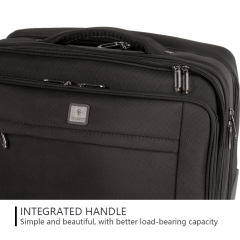
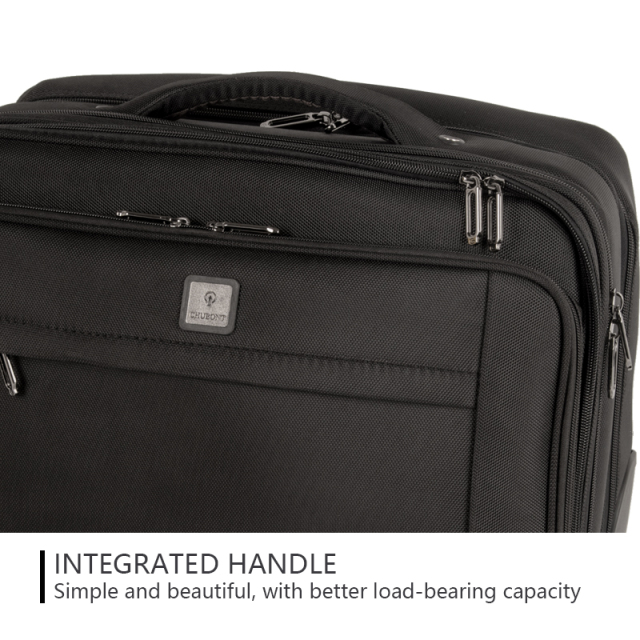
| Integrated top handle | Steps, station platforms, car boots and overhead bins |
| Detachable shoulder strap | Stairs, crowded platforms and narrow aisles |
| Strap removed and stowed | Rolling-only days, with the strap packed flat inside the case |
| Front and rear zip pockets | Passport, charger and boarding pass within reach at security |
Longer Trips and Set Building
- Three days is the pivot. Up to that point a 16-inch cabin case covers one traveller comfortably; beyond it the load grows faster than the case does — a second pair of shoes, a jacket, a week of shirts — and compressing it further strains the zip and creases everything inside.
- Move the bulk, keep the work kit. On a four-day trip or longer, clothing goes into a checked case while this one stays with the traveller as the cabin bag: laptop, documents, one change of clothes. A suitcase that arrives a day late no longer takes the meeting with it.
- Two people, three days. A single checked case plus a cabin case each is often the lighter arrangement than two large checked bags, and it keeps both travellers inside the same cabin allowance.
- Build the pair from one family. We supply a cabin model and a checked model from the same range, so wheels, handle, fabric and interior layout match across the two. Business travel luggage bought this way behaves the same in the hand whichever case the traveller picks up, and spares and staff briefing cover both sizes.
- One line item on the shelf. For a distributor or a corporate programme, a set answers the short trip and the long one without asking the buyer to choose between two products, and it gives the trade a higher-value unit than a single cabin case.
- Checked rules are not cabin rules. Hold allowances are set by airline, route and fare, and a case that travels free on one carrier can carry a fee on another. Confirm the limit for the routes your travellers actually fly before you fix the size mix.
- Keep the pair consistent in colour. When cabin and checked cases are ordered together, fabric and hardware come from the same confirmed specification, so they read as a set on the shelf and in a traveller's hands. Ordering the two months apart is where colour drift begins.
Specifications
| Property | Value |
|---|
| Model | LB-101087 |
| Cabin format | 16-inch upright cabin case |
| Wheels | Four 360° spinner castors |
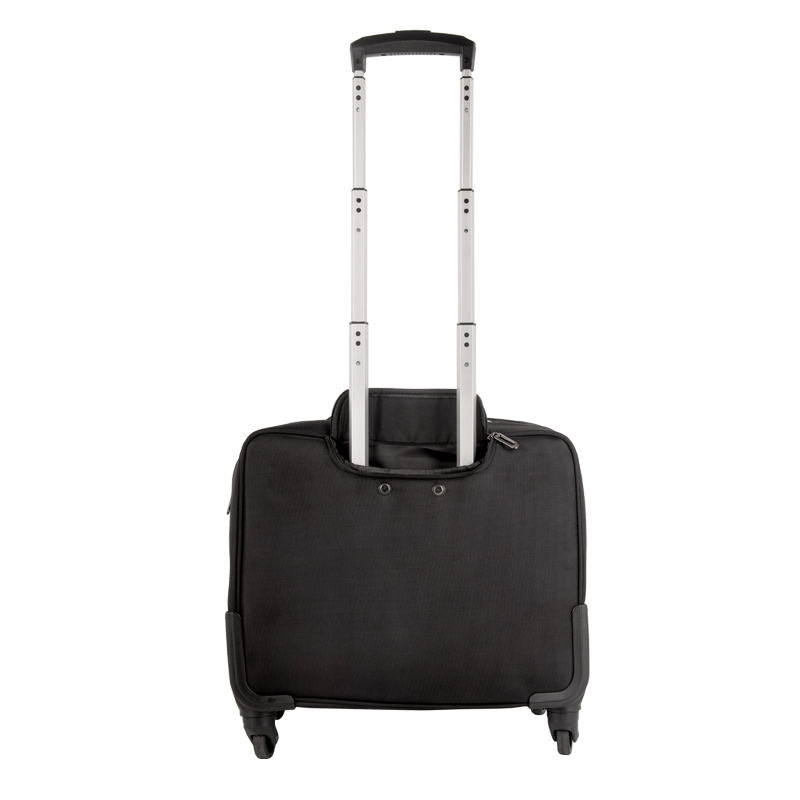
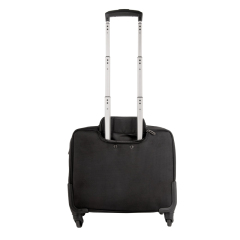
| Telescoping handle | Retractable, set into the back panel |
| Top handle | Integrated carry handle |
| Shoulder strap | Detachable |
| Interior | Padded laptop compartment plus main compartment |
| Pockets | Front and rear zip pockets |
| Trip length | 1–3 days for one traveller |
| Colour shown | Black |
| Closure | Zip closure |
Ordering and Delivery
- Start with the model and the size mix. Tell your sales contact you want this 16-inch cabin case and how many units per colour; for a wholesale luggage programme, send the full size run you intend to range so the cabin models and the checked models are planned together.
- Confirm colour and branding. Black is the standard finish. A different colour or a logo is a project decision, confirmed against your artwork and the decoration method before production starts.
- Confirm the packing. Packing runs as basic packing, custom packing or coordinated packing materials, matched to how your warehouse receives and checks cartons.
- Agree the commercial terms. Because we are the custom luggage manufacturer rather than a trading intermediary, terms come straight from our own production planning. Minimum order quantity depends on the product type, material, size, colour, logo process, packing and customization, so it is quoted per project. Trade terms such as FOB, CIF and DDP can be discussed with your sales contact.
- Ask about a sample. Talk to your sales contact about sample availability and about approving a prototype before mass production — colour and fittings are signed off at that stage.
- Confirm the schedule. Production and delivery timing are set per order; please do not plan a launch date on an assumed lead time.
- Sort the documents. We handle export logistics and paperwork for shipments to the Middle East, Asia, Africa, North America and Europe, and will confirm what your destination requires.
- Pre-shipment check. Before packing, the wheels, handle, zips and stitching are checked on the finished units, and you are welcome to appoint a third-party inspector to look at the goods before they leave.
Quality Control & Inspection
Every CHUBONT order passes five checkpoints inside our own workshops: incoming materials, pre-production samples, in-production patrols, finished-goods review, and a final pre-shipment check against the order. Batch records are kept, so buyers can see what was checked and when. You are welcome to send your own QC team, or appoint an independent inspector such as SGS or BV, to verify goods before they leave, and we support factory audits and on-site monitoring while production runs. Shipping marks, packing lists and carton labelling are confirmed against your instructions before loading.
FAQ
What is the 16-inch carry on luggage made from?
The body is a soft-sided woven fabric over a structured frame, which lets the case flex under handling instead of cracking. Exact fabric grade, backing and any surface finishing are confirmed against your approved sample before mass production rather than published as a fixed line that then shifts between batches. That matters on a lightweight spinner carry on luggage model, where a few grams of fabric weight change how the case behaves when it is full. If your market needs a particular finish or performance level, tell us when you enquire and we will match it to the closest construction.
Does the shoulder strap come off completely?
Yes. The strap unclips, and what is left is a carry on suitcase with wheels with nothing trailing behind it. On a travel carry on luggage piece the strap earns its place on stairs, station platforms and aircraft aisles, where wheels are more hindrance than help; off the airport it can stay clipped if the traveller prefers. Remove it before a flight if you want the cleanest profile at the gate, and stow it inside the case so it does not go missing in a hotel room.
Is there a padded compartment for a laptop?
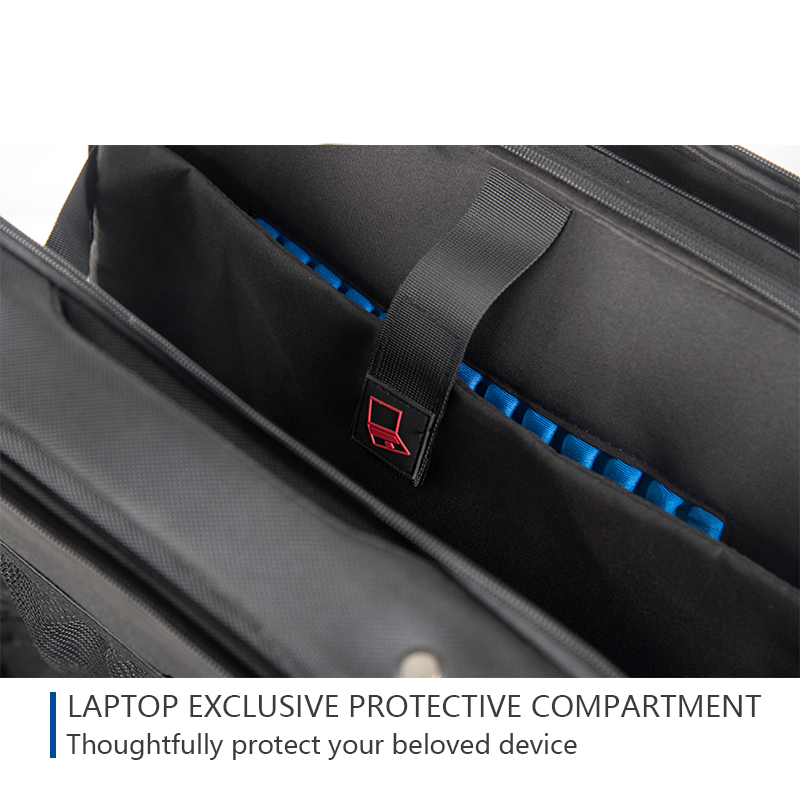
Yes. The padded compartment sits against the back panel and is kept apart from the main packing space, so a device and a folder are not pressed against clothing or a wash bag. That back panel is the stiffest part of a carry on suitcase with wheels, which is why the device pocket belongs there rather than in the middle of the load. Tell us the device sizes your team usually carries and we will confirm the fit on a sample before you commit to a batch.
Can we change the colour or add our logo?
Black is the standard colour on this spinner carry on luggage case. A different colour and a logo are project decisions rather than catalogue options: we confirm the colour direction and the decoration method against your artwork before production, and we will tell you what is practical on this model and where the logo can sit. Send the artwork file and the placement you have in mind, and we will come back with what is achievable on this lightweight spinner carry on luggage, including any effect on the fittings.
Is 16 inches enough for trips longer than three days?
For one traveller on a one- to three-day trip, yes. Beyond that the range moves up: 20-, 24- and 28-inch models cover longer itineraries and checked baggage. As a custom luggage manufacturer we can quote a mixed size run, so a team ends up with the right case for each kind of trip instead of one compromise. Most programmes pair this cabin model with a larger checked case rather than replacing it, which keeps short-trip travel carry on luggage light and keeps long trips workable.