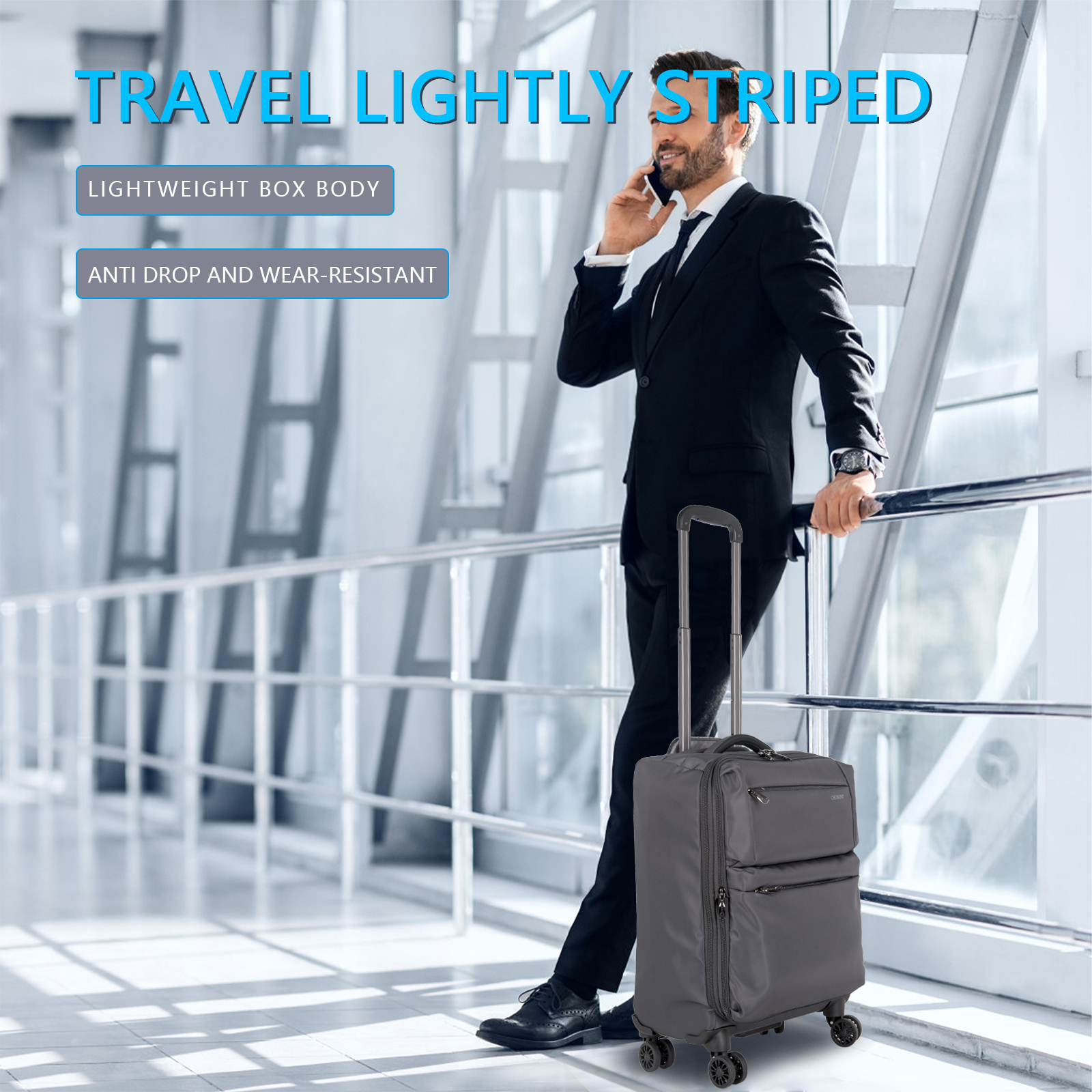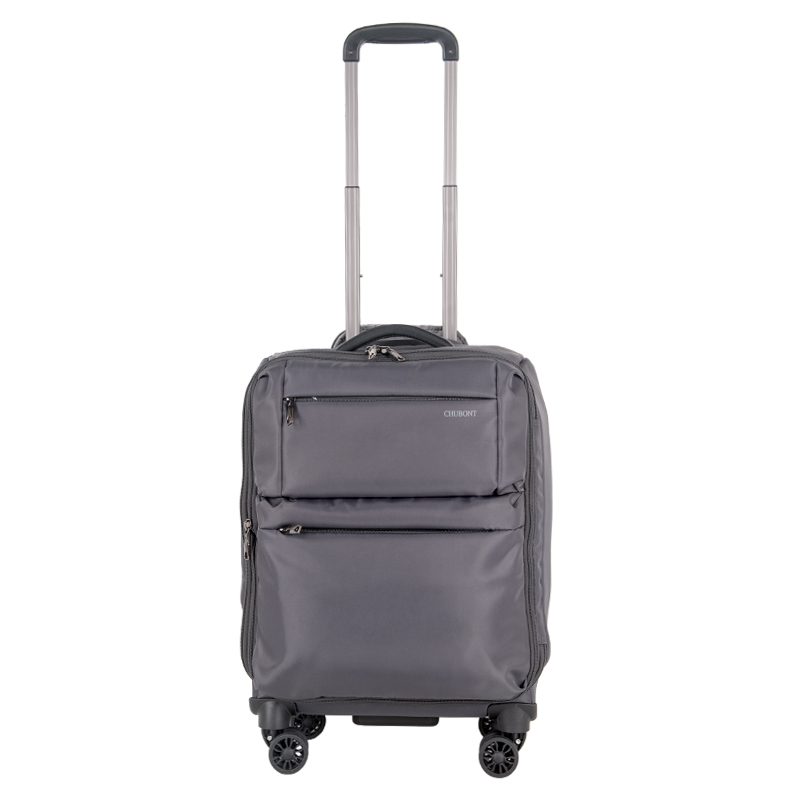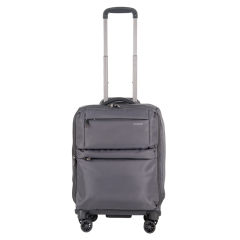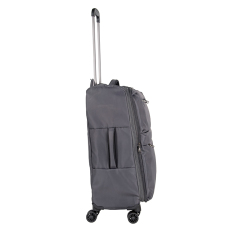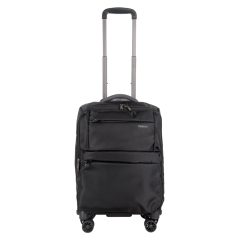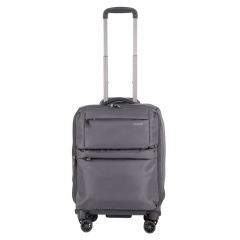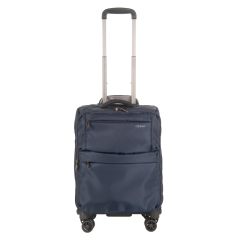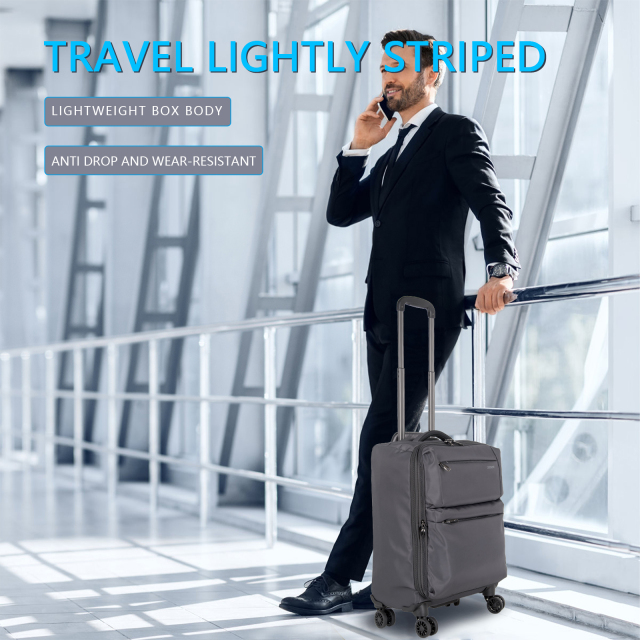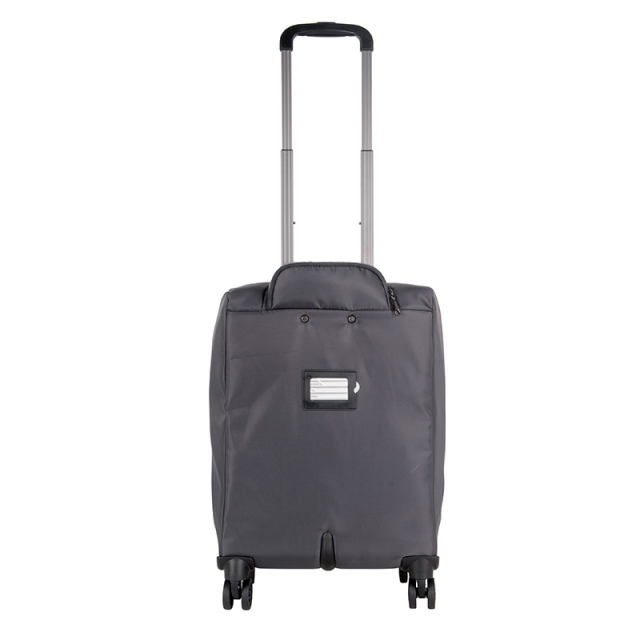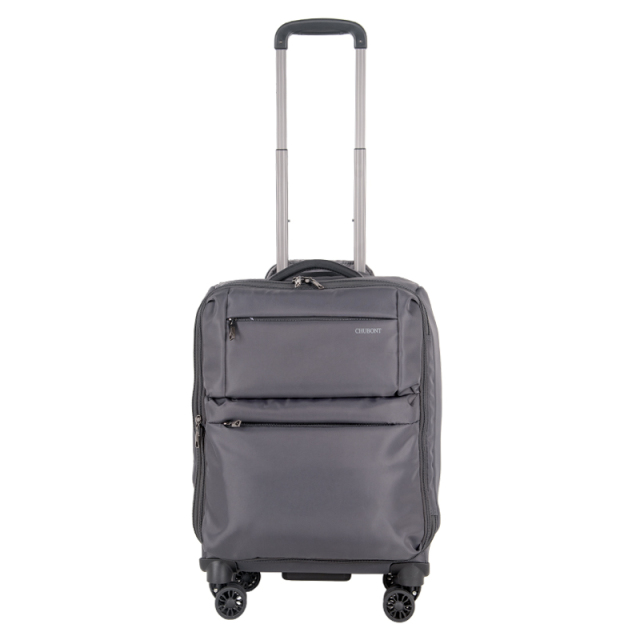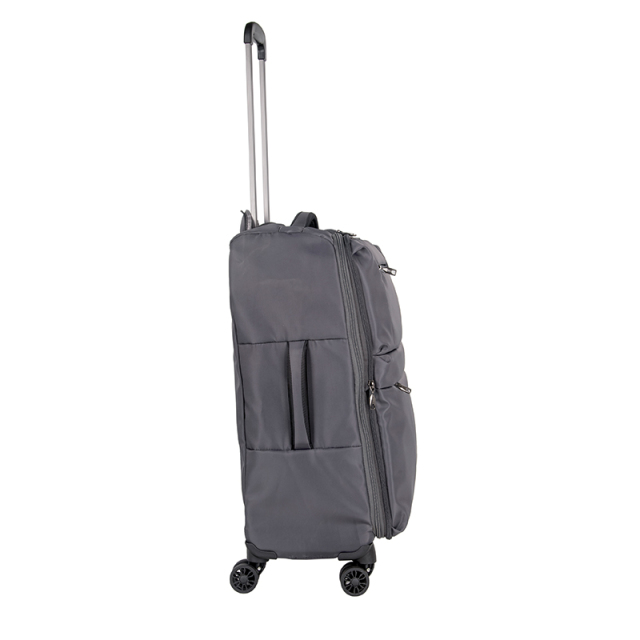
CHUBONT LB-101167 is a two-piece soft-shell set in high-tensile nylon: a 20-inch cabin case and a 24-inch case, each running on four independent spinner wheels. It is built for people who spend a large part of the year in transit — sales teams, project consultants, field engineers and the buyers who equip them — and for distributors who want one lightweight spinner carry on luggage option that covers a two-night trip and a five-day assignment without changing colour or hardware.
Where a hard-shell case forces a choice between capacity and weight, the nylon build keeps the empty case light enough to lift into an overhead bin one-handed and still take the knocks of a checked hold. Both sizes share the same shell fabric, wheel modules, handle and corner protection, so a team issued with the pair handles them the same way and a damaged unit is serviced without retiring the whole case.
Day to day the set works as a system. The 20-inch goes cabin-only for short trips; the 24-inch becomes the checked piece when the itinerary runs longer or when two people travel together. Every panel, zip and wheel exists to keep the case moving through an airport or a station — there is nothing decorative on it. The 20-inch case is intended for carry-on use and the 24-inch case for standard checked baggage; travelers should confirm the dimensions against their airline's current limits.
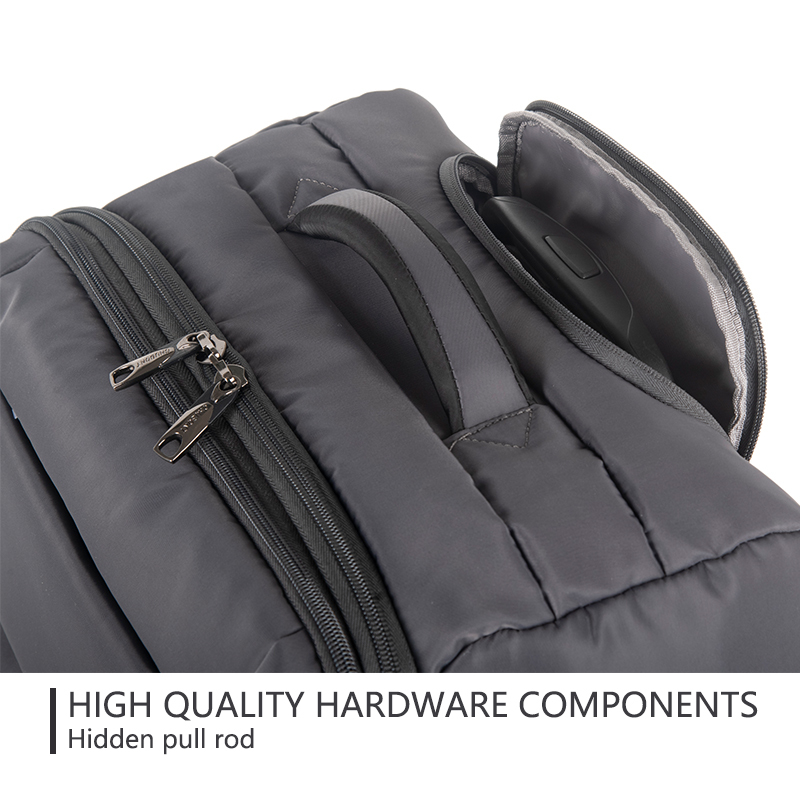
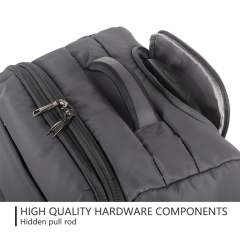
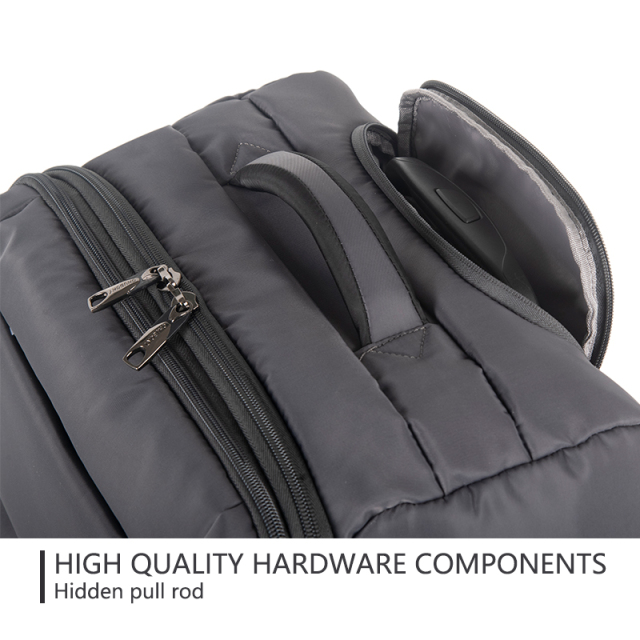
The zip is the part of a soft case that fails first, so it gets the attention. Every opening on both cases runs a security zip with reinforced tape and metal pulls, stitched into the shell along a double seam rather than a single line. That matters when the case is full: a loaded zip under tension is exactly where teeth split, and the extra seam takes the load instead of the coil.
The frame does the same job from the inside. A precision-moulded frame holds the shell's profile when the case is dropped or stacked, and it keeps the nylon from folding in on itself when the case is only half packed — which is when a soft case starts to look tired.
Corners carry moulded protectors at the four contact points. They absorb the scrape when a carry on luggage with spinner wheels is dragged off a belt or wedged into an overhead bin, and they keep wear away from the stitched seams directly behind them.
One practical note: pack to a little headroom rather than compressing everything down to the zip line. Over-packing strains the tape, pulls the frame out of shape and shortens the life of the case far faster than the miles do.
Both cases are built the same way: double-stitched high-tensile nylon over a precision-moulded frame, spinner wheel assemblies mounted as separate modules, and corner protection at the four points that meet a luggage belt first. The handles are bar-tacked into the shell rather than surface-stitched, because a handle takes a full case's weight every time someone lifts it.
For buyers running a fleet, the useful part is standardisation. As a custom luggage manufacturer we keep one component set across the range, so a batch of fifty or five hundred draws on the same wheels, the same handle assembly and the same zip specification. That does three things: a parts pool can be held against the whole order rather than against each size, a damaged unit is repaired from stock instead of being set aside, and a second order matches the first without a new development round.
It also makes a large order easier to accept against a fixed brief. Colour, fabric and hardware are agreed once and repeated across the run, so the batch that ships later in the year is the product that was approved, not an interpretation of it.
Buying luggage for an organisation is different from buying it for one trip. The question is not which case looks most professional but whether a year of travel can be planned around it: whether the same model will still be available when the second batch is needed, whether a replacement wheel or case can be sourced without changing the specification, and whether the set will still look like one range after a hundred flights. Working with a custom luggage manufacturer who owns the pattern removes most of that risk. Both sizes come from one fabric, one wheel module and one hardware set, so ordering more of either size does not create a second standard. Replaceable wheel modules mean wear is handled as maintenance rather than as a write-off, which shifts spend from replacement to servicing over the life of the kit. That is where the return sits for a corporate buyer: fewer mid-year emergency purchases, fewer mismatched cases accumulating in a store room, and a fleet that can be extended one size at a time as itineraries change.
The shortest trip is the one this set is easiest to justify. For a one to three day assignment the 20-inch travels as cabin baggage on most airlines, so the trip ends at the aircraft door rather than at a baggage carousel — which matters on a 6 a.m. departure or a same-day client visit. Inside there is room for a change of clothes, a laptop, contracts and chargers, with the zipped sections keeping paperwork away from clothing. That makes the 20-inch the piece to take when you want lightweight spinner carry on luggage that never leaves your side. The nylon body keeps it light enough to lift into an overhead bin without help, and small enough to sit in an office locker or under a desk between trips — so a frequent traveller can leave it at work and pack on the morning of departure instead of hauling a larger case back and forth. For a first order it is also the simplest unit to place: one size, one specification, and a clear answer to what it is for. The nylon shell is lighter than hard-shell luggage, which helps reduce the load for business travel; it is scratch-resistant and splash-proof for rainy commutes and airport stacking, and reinforced corners support frequent, long-term use.
Airline rules move, and they move differently from carrier to carrier. The 20-inch in this set is sized to sit inside the cabin limits most global carriers publish, which is what lets a consultant or an account team board with the case rather than queue at the desk and hope it arrives with them. The 24-inch is sized so it can also be checked where a longer itinerary demands it, so a team travelling together is not split between two incompatible formats. For organisations that issue luggage rather than sell it, the practical benefit is that the case slots into an existing handover process. It can be labelled, signed out and returned on the same cycle as the rest of a kit list, and because both sizes come from one specification, an allocation decision becomes a question of trip length rather than of brand, model or hardware. A business travel luggage set that behaves this way keeps the conversation on the assignment instead of on the bag. Check the allowance on each carrier your team actually flies. Cabin limits vary by aircraft and fare class, and a case that passes on one route can be refused on another.
| Size | Cabin or checked | Typical itinerary | Core business application |
| 20 inch | Can be carried on board | 1-3 day itinerary for 1 person, for short-term business trips or travel | Single-day client visits, short-haul fieldwork, in-city training |
| 24 inch | Can be carried on board or checked in | 1-5 day itinerary for 1 person, for short-term business trips or travel | Cross-city negotiations, out-of-town exhibitions, multi-city visits |
| 28 inch | Cannot be carried on board | 7-10 day itinerary for 2 people, for short-term overseas travel or a long-term business trip | Not part of this set; supplied separately for group assignments |
For teams, standardizing on the set supports uniform tracking and asset rotation across assignments, and the durable construction helps reduce breakage and loss over repeated use.
The set is two cases and nothing else: a 20-inch cabin case and a 24-inch case, cut from the same high-tensile nylon and finished with the same hardware. There are no storage bags, packing cubes or straps in the box — the organisation lives inside the cases, in the main compartment and the zipped sections that hold documents, chargers and smaller items. Because both pieces come off one specification, this 2 piece luggage set with spinner wheels behaves as a single product rather than two. Same four-wheel base, same multi-position telescopic handle, same reinforced corner protectors, same zip pulls. A team issued with both sizes does not have to learn two different cases, and a colour decision made once carries across the whole batch. Each case is double-stitched along its seams and built over a precision-moulded frame. That construction is what lets the nylon body stay light while still holding its shape when the case is full and handed to a bag handler.
| Shell material | High-tensile nylon with double-stitched seams |
| Frame | Precision-moulded internal frame |
| Set contents | 20-inch case and 24-inch case |
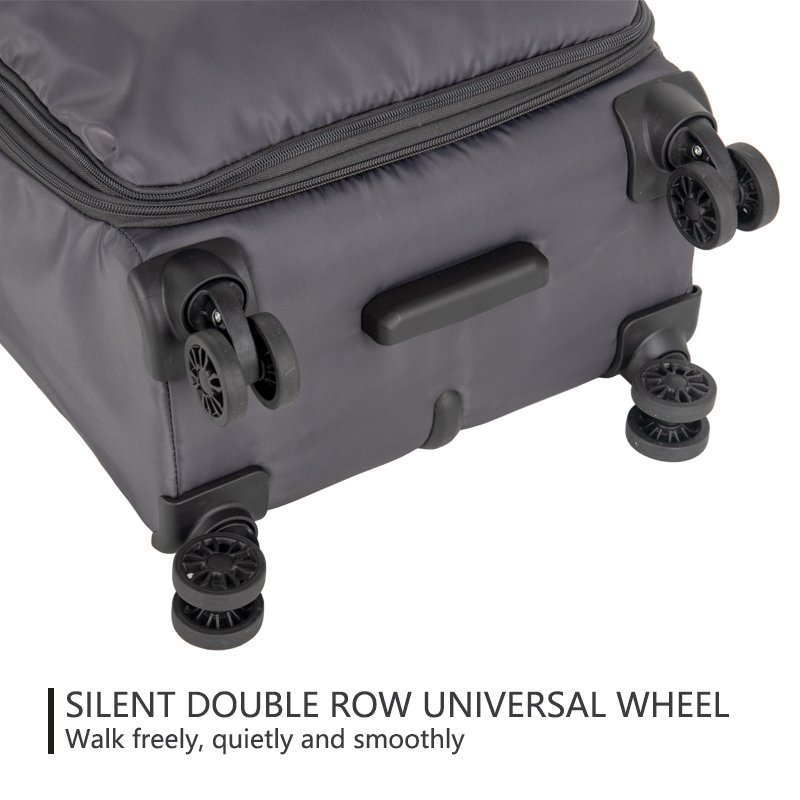
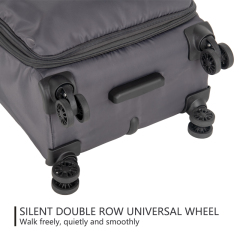
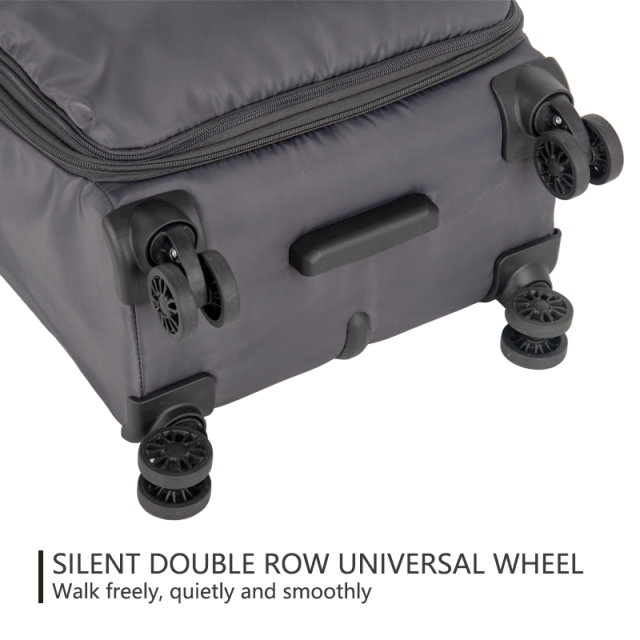
| Wheels | Four independent 360° spinner wheels per case |
| Wheel modules | Individually replaceable |
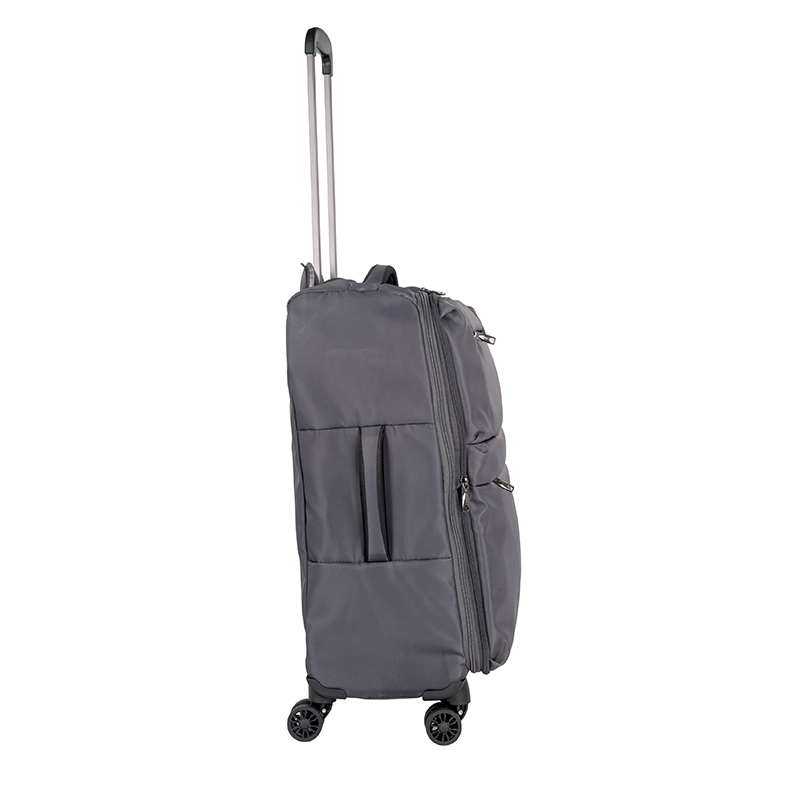
| Handle | Multi-position telescopic handle, plus top and side carry handles |
| Corners | Reinforced corner protectors |
| Zips | Security zips with reinforced tape and metal pulls |
| Colours | Black as standard, with grey and blue also available |
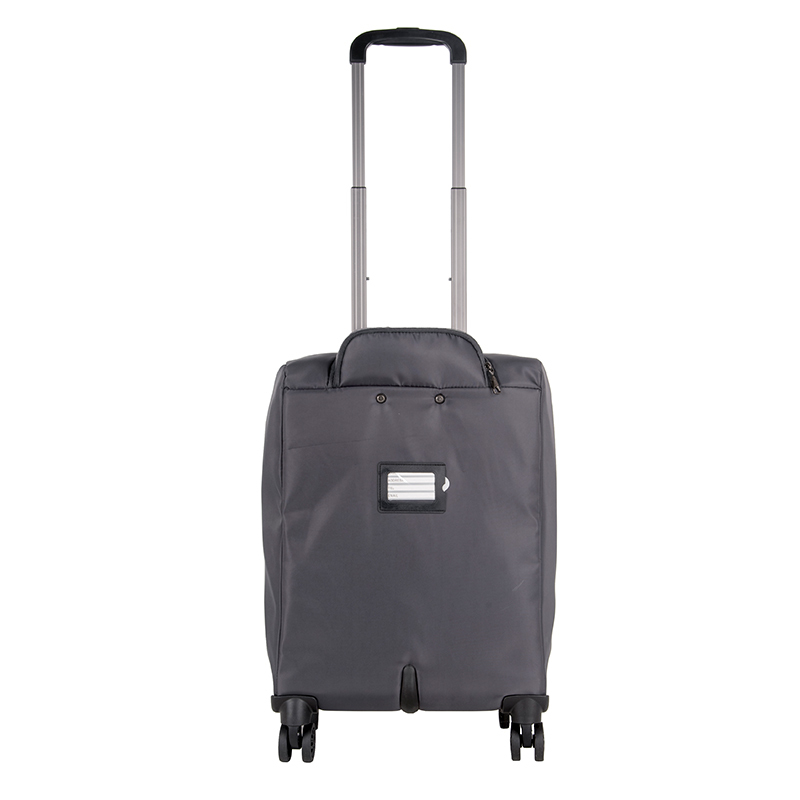
| Tag | Clear luggage tag window on each case |
| Extras included | None — no storage bags or straps in the set |

Every CHUBONT order passes five checkpoints inside our own workshops: incoming materials, pre-production samples, in-production patrols, finished-goods review, and a final pre-shipment check against the order. Batch records are kept, so buyers can see what was checked and when. You are welcome to send your own QC team, or appoint an independent inspector such as SGS or BV, to verify goods before they leave, and we support factory audits and on-site monitoring while production runs. Shipping marks, packing lists and carton labelling are confirmed against your instructions before loading.
- Issue by role. Staff who only need devices and credentials take the 20-inch; the 24-inch goes to whoever carries samples, printed materials and giveaways. One spinner luggage set covers both jobs without ordering two products. - Recognisable on a busy floor. A matched shell and colour across a delegation makes company kit easy to spot at a registration desk, on a stand or during a coach transfer. - Fast issue and recovery. Two sizes and one specification keep sign-out sheets short and let returning kit be checked against a known list rather than against a mix of donated cases. - Movement across multiple points. Modular wheels handle the walk from a loading bay to a hall floor, then from the hall to the transport, without a trolley for every leg. - Repeatable for the next event. Because this is a standard model rather than a one-off, a wholesale luggage order can be topped up for next season and the stock will still match.