

Introduction: Before bulk approval, 8 test categories and 3 decision states distinguish demonstrated spinner-luggage performance from missing evidence and unresolved production changes.
Define What Sample Approval Must Establish
Before ordering spinner luggage in bulk, a buyer should request a written qualification plan linking intended use, sample identity, test methods, and acceptance criteria. Approval should answer a bounded question: does this identified configuration meet the agreed requirements under the documented conditions? It should not be interpreted as proof that every production unit will be identical or that every future journey will be trouble-free.
CHUBONT's LB-101157 28-inch softside checked suitcase provides a concrete inquiry example. Its product page identifies an expandable softside model for business travel. That description helps define the test subject, but the buyer still needs model-specific records before making durability or production-approval conclusions.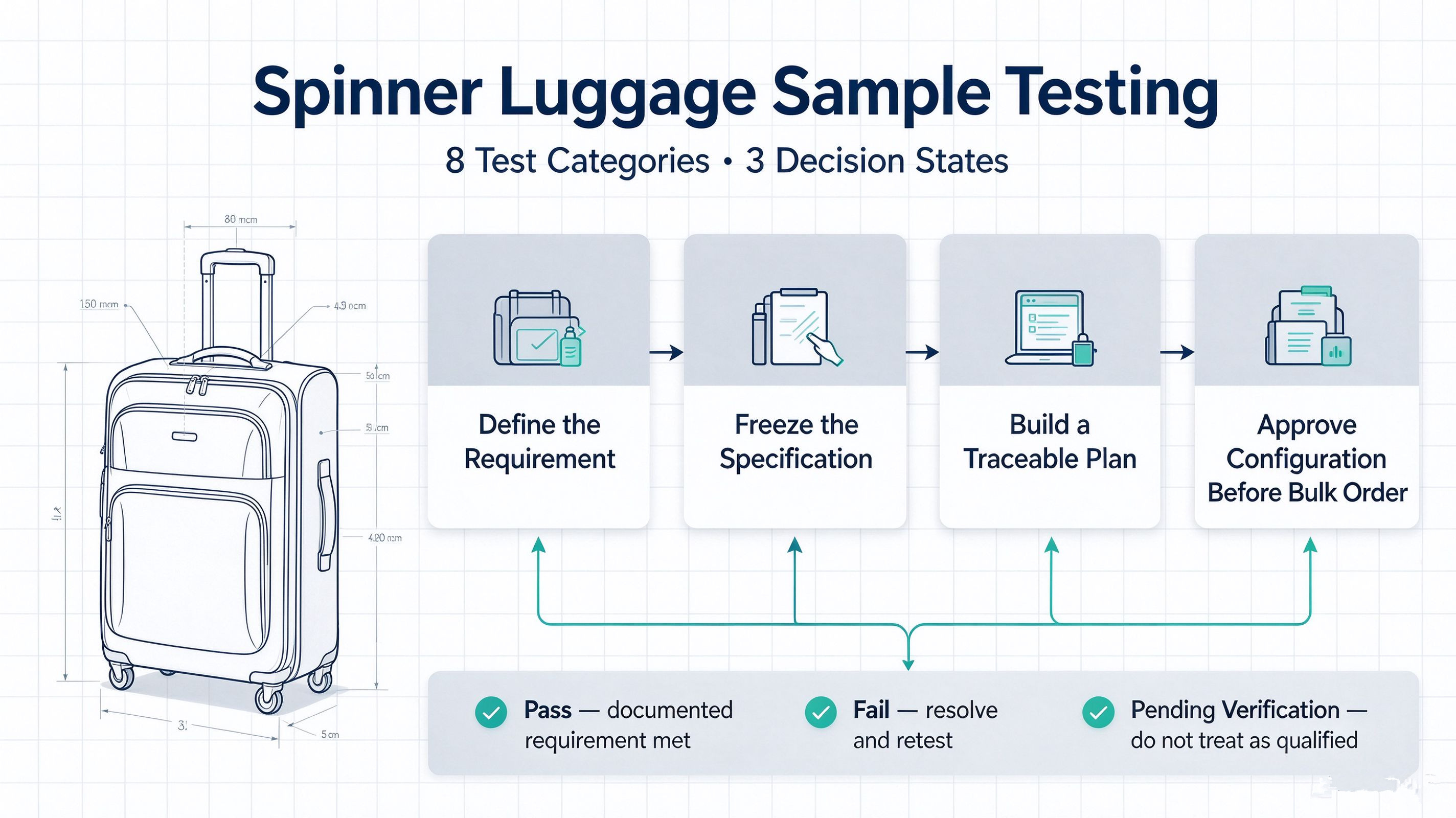
Identify the Sample Type and Intended Decision
Distinguish a sales sample, engineering sample, pre-production sample, and unit randomly selected from production. A hand-prepared demonstration piece may support design discussion without representing routine assembly. Record who selected each unit, where it came from, and whether its components and manufacturing process match the planned order.
Avoiding Approval Beyond the Available Evidence
Label the decision precisely. Design approval, functional qualification, packaging approval, and shipment release are separate decisions. If only an appearance sample has been reviewed, do not record general bulk approval. Where a test is missing or an essential condition is unclear, retain a pending status rather than assuming that silence means conformity.
Freeze the Specification Before Testing
Testing an unstable specification creates an interpretation problem: the buyer may approve one construction and receive another. Freeze the relevant characteristics before commissioning work. That does not prohibit later improvements; it establishes which changes require review and potentially retesting.
Create a Traceable Sample Record
Prepare a numbered sample dossier:
1. Assign a unique sample identifier and photograph all sides and hardware.
2. Record the model, revision, intended factory, and selection date.
3. Identify fabric, wheel assemblies, trolley, zippers, reinforcements, and attachments.
4. Define measurement conditions, packed contents, expansion state, and accessories.
5. Attach approved drawings, tolerances, test plan, and result forms.
6. Allocate specimens for destructive tests and retain an untouched reference where practicable.
Include the allocation and test sequence. Repeatedly using one sample for unrelated exposures may answer a cumulative-damage question, while separate specimens may isolate individual failure modes. Choose deliberately with the laboratory rather than allowing specimen availability to determine the interpretation after testing.
Control Configuration Changes After Approval
Require written disclosure of substitutions, including changes that the supplier considers equivalent. Record the reason, affected characteristics, and verification decision. A shared model name is not sufficient evidence that a different wheel housing or zipper attachment has the same performance.
Build a Risk-Based Sample Test Plan
The following eight categories organize a buyer's request. They are a proposed procurement structure, not a universal luggage certification scheme. Select complete methods with the laboratory and supplier; public method summaries do not supply a finished protocol. Agree loads, exposures, sample counts, conditioning, and decision rules before testing begins.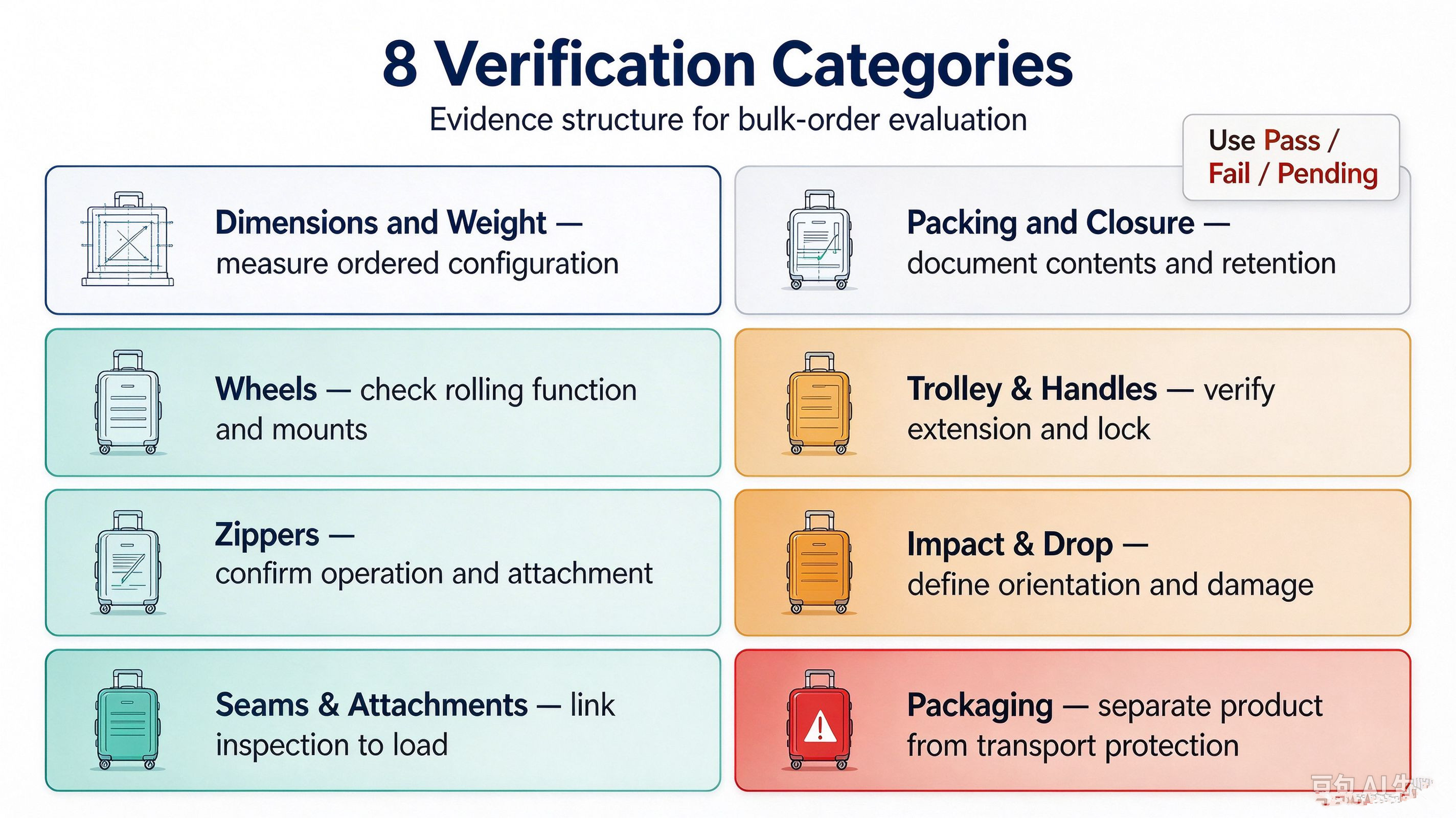
Dimensions and Empty Weight
Measure the actual ordered configuration and distinguish unexpanded from expanded conditions. Record protrusions and the location of each measurement. Weigh with agreed accessories and a suitable instrument. Compare results with the approved specification, not an undefined interpretation of the nominal inch label.
Define Measurement Points and Sample Configuration
The proposed acceptance rule is conformity to the signed dimensional and mass limits using the recorded measurement setup. Include how uncertainty or borderline measurements will be handled. A photograph of a tape measure without defined endpoints cannot settle a close dimensional dispute reliably.
Loaded Packing and Closure
Use representative contents and document their mass, distribution, orientation, and any restraint. Include bulky items where they are part of the actual requirement. Observe internal fit, panel distortion, and access to the closure. Do not use uncontrolled overpacking as a substitute for an agreed loading condition.
Use a Documented Packing Arrangement
A practical proposed criterion is that the specified contents can be enclosed, secured, and accessed without closure separation or attachment damage during the agreed procedure. Define any assistance permitted during closing. Record deviations rather than quietly repacking the sample until it appears to pass.
Wheel Movement and Mounting Integrity
Evaluate loaded movement and inspect wheel alignment, housings, fasteners, and the supporting base before and afterward. SATRA TM248 addresses abrasion and structural damage during prolonged wheeling. A report should identify the sample, rolling arrangement, exposure, and observed outcome; a wheel supplier's component result is not automatically an assembled-case result.
Separate Rolling Performance from Structural Condition
Request both functional observations and structural inspection. Proposed failures include a detached assembly, seizure, or damage that prevents the specified rolling function. Define permissible cosmetic wear separately. If force or steering deviation is measured, its limit and measurement method must already be part of the plan.
Telescopic Handle Operation
Inspect extension, retraction, release controls, and lock engagement before and after exposure. SATRA TM245 concerns collapsing strength, while TM246 addresses bending strength. The methods cover different conditions; neither title alone establishes a particular extension-cycle requirement. Specify any additional repeated-operation evaluation separately.
Record Extension, Locking, and Post-Test Function
Define intended locking positions and unacceptable outcomes, such as unintended collapse, permanent deformation preventing retraction, or attachment failure. Carry-handle lifting is a separate task: SATRA TM247 evaluates repeated lifting of loaded luggage. Specify which handle is tested rather than using an undifferentiated handle passed statement.
Zipper Operation and Attachment
Request relevant strength and operability evidence. ASTM D2061 and D2062 address these respective areas. Also inspect the zipper's sewn connection to the suitcase: component evidence may not represent the assembled seam, panel geometry, or strain created by the chosen packing arrangement.
Inspect the Closure System Before and After Testing
Record slider travel, element separation, stop condition, tape damage, and stitching. Proposed functional criteria should require content retention and completion of the intended opening-and-closing operation under defined conditions. Select quantitative limits with the laboratory where appropriate, rather than inventing a universal zipper force or cycle count.
Impact and Drop Resistance
Choose exposure according to the intended handling risk. SATRA TM242 addresses loaded luggage corner impact through a defined drop method. Ask the laboratory to identify the complete procedure and edition. A promotional video showing a suitcase dropped once does not establish compliance with that procedure.
Specify the Method Before Interpreting the Result
Record loading, orientation, height, sequence, conditioning, and inspection timing as applicable to the chosen method. Define damage classifications beforehand. Check agreed functions afterward, including rolling, handle locking, and closure retention. Any additional post-impact checks should be explicitly included rather than implied by the test title.
Seams, Pockets, and Structural Attachments
Inspect stitching, reinforcement locations, lining attachments, pockets, and hardware interfaces against the approved construction. Determine which pockets are expected to carry equipment and which serve light accessories. A visual inspection can identify deviations, but it cannot establish seam strength without a suitable evaluation.
Link Inspection to the Intended Load and Use
Agree the relevant loading or strength procedure and the permitted damage. Proposed rejection conditions include rupture or detachment that defeats a specified function. Keep cosmetic thread trimming and structural seam failure in separate classifications. Record location and scale in photographs so inspectors can reproduce the assessment.
Packaging and Shipment Condition
Review the product as shipped, including carton, protective materials, orientation, and accessories. ISTA 3A addresses packaged products in parcel delivery systems within its stated scope. Whether that procedure fits the actual distribution route must be assessed; a palletized shipment should not automatically inherit a parcel-test plan.
Keep Product Performance and Packaging Protection Distinct
Packaging qualification asks whether the shipped package and product withstand the specified transport exposures. It does not establish luggage durability during employee travel. Record packaging damage and product condition separately, and confirm the final production packaging matches the tested arrangement.
Set Acceptance Criteria Before Reviewing Results
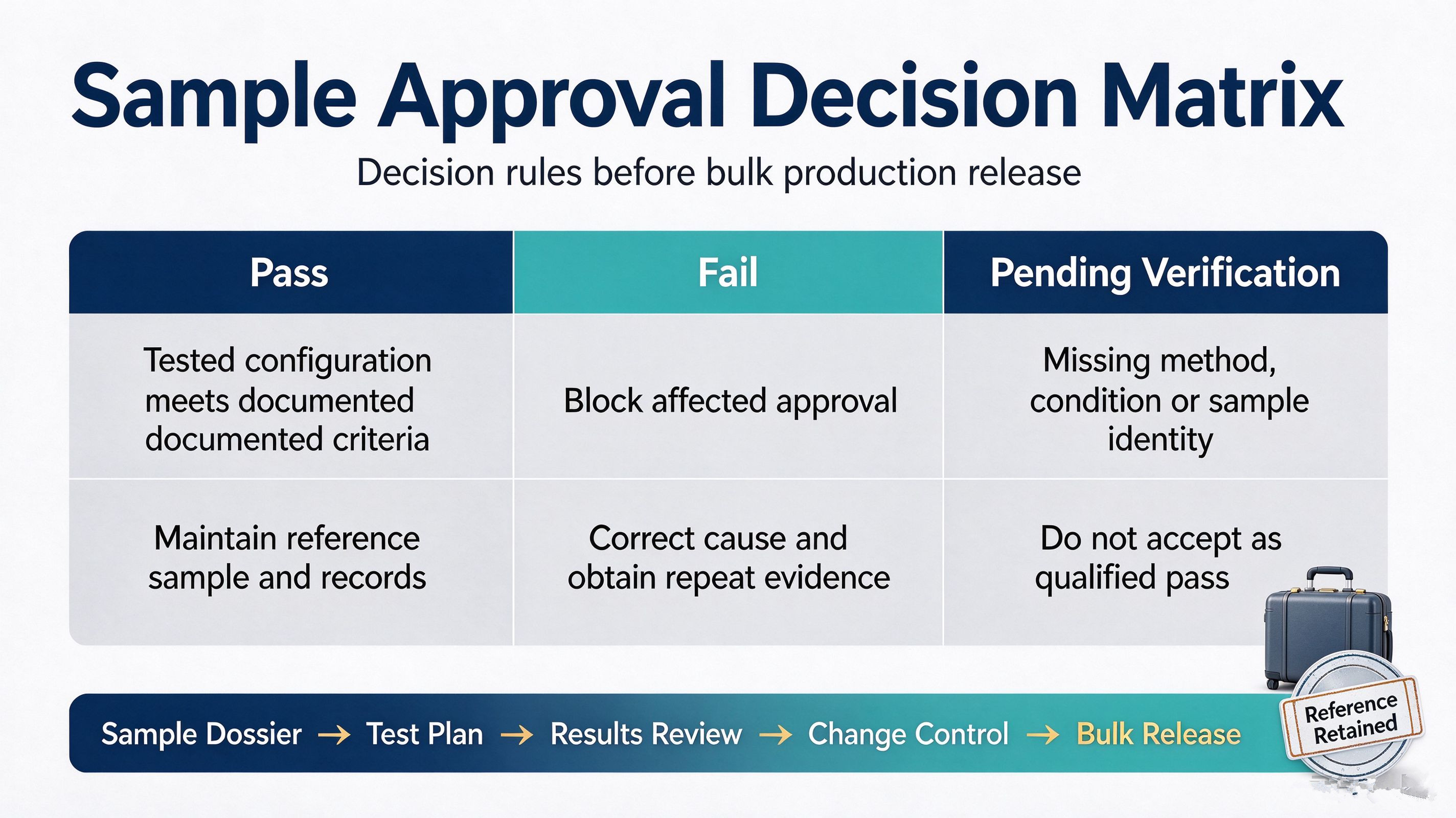
Use Pass, Fail, and Pending Verification as explicit decision states. Pass means the defined requirement was met under documented conditions. Fail means a defined requirement was not met. Pending Verification means the evidence cannot support a decision, perhaps because the condition, sample identity, or result is missing. Pending is not a qualified pass.
Apply decision priority before commercial preferences. Requirements involving safe handling, content retention, or a mandatory fit condition receive blocking priority. Other functional deviations require technical disposition. Cosmetic preferences can be reviewed only within their signed criteria; they should not offset a blocking failure. This priority structure is a suggested review method, not a standardized defect classification.
| Recorded state | Approval consequence |
|---|---|
| Pass | The recorded requirement is satisfied for the tested configuration and conditions. |
| Fail | Resolve the nonconformity and obtain the required repeat evidence before affected approval. |
| Pending Verification | Obtain missing information or testing; do not represent the requirement as satisfied. |
Write Criteria That Another Inspector Can Reproduce
The compact matrix below is a specification aid, not a completed test record. Each row requires a linked procedure containing the configuration, method, conditions, requirement, and record fields. Proposed functional criteria must be supplemented by agreed quantitative limits wherever dimensions, force, duration, or exposure determine conformity.
| Test category | Proposed acceptance basis | Required record |
|---|---|---|
| Dimensions and weight | Within agreed specification limits | Measurements and configuration |
| Packing and closure | Specified contents enclosed and retained | Packing map and observations |
| Wheels | Required rolling function retained; mounts intact | Exposure and before/after condition |
| Trolley and carry handles | Required operation retained; no specified failure | Handle identity and loading record |
| Zippers | Required closure and operation retained | Component and attachment results |
| Impact | No prohibited damage; required functions retained | Orientations and post-test checks |
| Seams and attachments | No prohibited rupture or detachment | Location-linked inspection results |
| Packaging | Agreed package/product criteria met | Shipping configuration and damage record |
Define the Requirement, Method, Condition, and Decision
For example, do not write only wheels durable. Identify the wheel configuration, selected rolling procedure, agreed loading and exposure, disallowed outcomes, and evidence to retain. Write the eventual status beside that record. This converts a subjective judgment into a reviewable decision without pretending that this article supplies universal test settings.
Classify issues separately from test status. A functional or safety-related failure should block the affected approval until resolved. A cosmetic deviation may follow a different disposition if the signed criteria permit it. Missing evidence requires verification, not retrospective relaxation of the requirement to preserve a delivery date.
Review Test Reports and Unresolved Deviations
A credible review starts with applicability, not the report's decorative cover. Confirm the issuing organization, report identifier, specimen photographs, dates, methods, conditions, and result details. Request original or verifiable reports where authenticity matters. A cropped pass statement obscures the information needed to judge its relevance.
Check Whether the Report Applies to the Ordered Product
Match hardware and construction to the approved dossier. ISO/IEC 17025 provides requirements for laboratory competence; if accreditation is specified, verify its relevant scope. Accreditation is not product certification. Also check whether subcontracted work, deviations, or excluded tests affect the buyer's intended conclusion.
Resolve Missing Conditions and Configuration Mismatches
Maintain a deviation register with the issue, consequence, action owner, supporting evidence, and closure decision. Request clarification where information exists but is unclear; retest where essential conditions or construction differ materially. Do not average a failed functional result into a favorable overall impression. The requirement still needs a defensible disposition.
Connect the Approved Sample to Bulk Production
Qualification and production inspection solve different problems. Qualification examines whether an identified design meets specified performance requirements. Lot inspection examines a defined production population using an agreed inspection arrangement. Neither activity eliminates the need for the other.
Preserve the Reference and Control Changes
Retain the signed reference sample, specification revision, bill of materials, approved packaging, and report package. Specify how production units are selected for inspection and how nonconforming findings are handled. ISO 2859-1:2026 provides AQL-indexed attribute sampling schemes for lot-by-lot inspection; it is not a luggage endurance method or a guarantee that every accepted unit is defect-free.
Define When Retesting Is Required
Set triggers before ordering: for example, a change in wheel assembly, trolley construction, zipper system, attachment design, or manufacturing process that could affect the verified requirement. Determine the necessary scope from the change's consequences. A paperwork revision and a structural substitution should not automatically receive identical treatment.
Specify responsibility for corrective work and repeat verification, including when production may resume. Where the order spans multiple deliveries, preserve revision and lot identifiers so an approved change does not become an undocumented mixture. This is especially important when spare assemblies must remain compatible with luggage already issued to employees.
Before production release, hold a documented approval meeting covering the specification, outstanding deviations, report applicability, and retained reference. Name the person authorized to close each issue. Commercial acceptance of a concession should be recorded as a concession, not rewritten as an unqualified technical pass.
If delivery urgency prevents completion of a test, state the remaining uncertainty and the restricted decision being made. Avoid a general approval signature that hides incomplete qualification. The buyer can then decide whether to postpone, narrow the order, or obtain additional evidence, with responsibility and unresolved risk visible to everyone reviewing the purchase.
Apply the Checklist to a CHUBONT Luggage Inquiry
Use the product page to start a precise supplier conversation. CHUBONT's LB-101157 model page lists 3.2 kg, a nylon body, spinner wheels, and an aluminum telescopic handle. Request confirmation for the offered revision rather than interpreting those published details as completed qualification evidence.
A useful inquiry separates required evidence from optional improvements. Send the frozen specification and ask the supplier to mark each requested record as available, unavailable, or requiring new work. Request an estimated verification schedule for gaps without treating the schedule as a test outcome. This gives purchasing and technical reviewers the same view of what remains before an order can be released.
Request Model-Specific Evidence
Ask CHUBONT for a traceable sample, component identification, relevant mechanical reports, proposed test conditions, and production-control records. Its OEM/ODM page describes customization services; request explicit change review for any proposed order-specific construction or packaging. Customization availability does not establish tested equivalence.
Separate Published Features from Approval Records
The IndustrySavant discussion of right-sizing luggage offers context for selecting capacity around actual trips. It does not set acceptance limits. Keep that contextual reading separate from the signed specification, laboratory results, and approval record. Apply the same separation to any brand's descriptive product claims.
Frequently Asked Questions
Q1: How many samples should a buyer request?
A: Agree the number with the laboratory according to test methods, destructive exposures, configuration variants, and desired evidence. A convenient single sample is not automatically sufficient. Production-lot sampling requires a separate plan tied to the defined lot and inspection objectives.
Q2: What universal load or cycle count should be used?
A: There is no universal figure established by this article. Select the complete method and applicable conditions, then agree requirement-specific settings with competent technical support. Do not substitute an invented number for a method or a documented use requirement.
Q3: Can supplier videos replace test reports?
A: They may supplement observations, but they do not replace missing sample identity, procedures, conditions, results, or acceptance rules. The buyer should be able to trace the recorded demonstration to the approved sample and understand exactly what it establishes.
Q4: Does an accepted AQL inspection prove durability?
A: No. Attribute sampling addresses lot inspection under the selected scheme. Durability qualification requires suitable performance evaluations. Acceptance also does not mean every unit was inspected or that an AQL value guarantees a fixed defect percentage in a shipment.
Q5: What should happen after a failed sample test?
A: Record the failed requirement, investigate the cause, approve the proposed correction, and determine the necessary repeat tests. Keep the affected approval closed until the required evidence is available. Do not transfer approval from an earlier configuration without reviewing applicability.
Conclusion
Bulk approval should rest on a traceable configuration, reproducible acceptance criteria, and evidence matched to the intended decision. The eight-category plan separates performance qualification, packaging review, and production inspection while making missing evidence visible. Buyers evaluating CHUBONT's LB-101157 28-inch softside checked suitcase can use that structure to request model-specific records and control changes before the approved sample becomes a bulk order.
References
-
Web sources checked on October 24, 2026. Public method descriptions establish scope; complete procedures and agreed limits are required for testing.
Sources
- SATRA TM248: Performance of wheels systems - rolling road
https://www.satra.com/test_methods/detail.php?id=203
Note: Describes evaluation of wheeled luggage for abrasion and structural damage during prolonged wheeling.
- SATRA TM245: Luggage trolley handles - collapsing strength
https://www.satra.com/test_methods/detail.php?id=200
Note: Identifies a compression-based assessment of locking trolley handles, distinct from carry-handle lifting.
- SATRA TM246: Luggage trolley handles - bending strength
https://www.satra.com/test_methods/detail.php?id=201
Note: Provides the scope of a trolley-handle bending evaluation.
- SATRA TM247: Luggage handle strength - repeated lifting
https://www.satra.com/test_methods/detail.php?id=202
Note: Describes repeated lifting of loaded luggage and assessment of handle or frame damage.
- ASTM D2061-07(2021): Standard Test Methods for Strength Tests for Zippers
https://store.astm.org/d2061-07r21.html
Note: Explains the scope of zipper strength testing and the limits of individual test results.
- ASTM D2062-03(2021): Standard Test Methods for Operability of Zippers
https://store.astm.org/d2062-03r21.html
Note: Separates opening-and-closing operability from zipper strength assessment.
- SATRA TM242: Luggage corner impact strength - drop test
https://www.satra.com/test_methods/detail.php?id=197
Note: Describes a loaded-luggage corner-impact method without substituting for the complete test procedure.
- ISTA 3A: Packaged-products for parcel delivery system shipment - overview
https://ista.org/docs/3Aoverview.pdf
Note: Provides scope information for packaged-product transport testing, separate from luggage service performance.
- ILAC: About laboratory accreditation
Note: Explains independent competence assessment and the use of ISO/IEC 17025 for testing laboratories.
- BSI: BS ISO 2859-1:2026 - Sampling procedures for inspection by attributes
Note: Identifies the current AQL-indexed lot-inspection standard and its scope.
- NIST/SEMATECH e-Handbook: What is Acceptance Sampling?
https://www.itl.nist.gov/div898/handbook/pmc/section2/pmc21.htm
Note: Explains the role of random sampling in decisions about production lots.
Related Examples
- CHUBONT LB-101157 28-inch softside checked suitcase
https://chubont-luggage.com/pages/lb-101157-28-inch-softside-suitcase
Note: Provides the supplier-published model specifications used as a verification case, not independent test results.
- CHUBONT: OEM and ODM luggage manufacturing
https://chubont-luggage.com/pages/oem-odm
Note: Describes customization services relevant to questions about configuration and change control.
Further Reading
- Right-Sizing Luggage for Business Trips: Capacity, Use, and Waste Prevention
https://www.industrysavant.com/2026/10/right-sizing-luggage-for-business-trips.html
Note: Discusses trip fit and capacity choices as contextual reading rather than mechanical qualification evidence.
This post was reproduced from: Emily Q. Harris


