
Introduction: Nested luggage sets can cut wasted carton volume in container shipping because smaller cases fill the empty space inside larger ones.
A container is billed by space, not by good intentions. When a shipment is made up of one suitcase size, every carton has to protect a full-size shell, even though most of that shell is air. Nested packing changes the math by turning that empty inner space into cargo space. The idea is simple: a 20-inch case goes inside a 24-inch case, and both can sit inside a 28-inch case, so the outer carton carries a set rather than a stack of half-empty boxes. The useful question is how nesting affects carton volume, container cube, and export packing.
Single-size shipping looks tidy in a warehouse. Every carton has the same footprint, so stacks line up neatly and pallet patterns are easy to repeat. The problem is inside the carton. A suitcase is a shell with a handle, wheels, lining, and a large internal cavity. When only 28-inch cases are packed, each outer carton is sized around one large case, and that case travels with its internal cavity mostly empty. The carton also needs padding and clearance around wheels and handles. This creates void space that cannot be used for another product. Nested sets attack that void space directly. 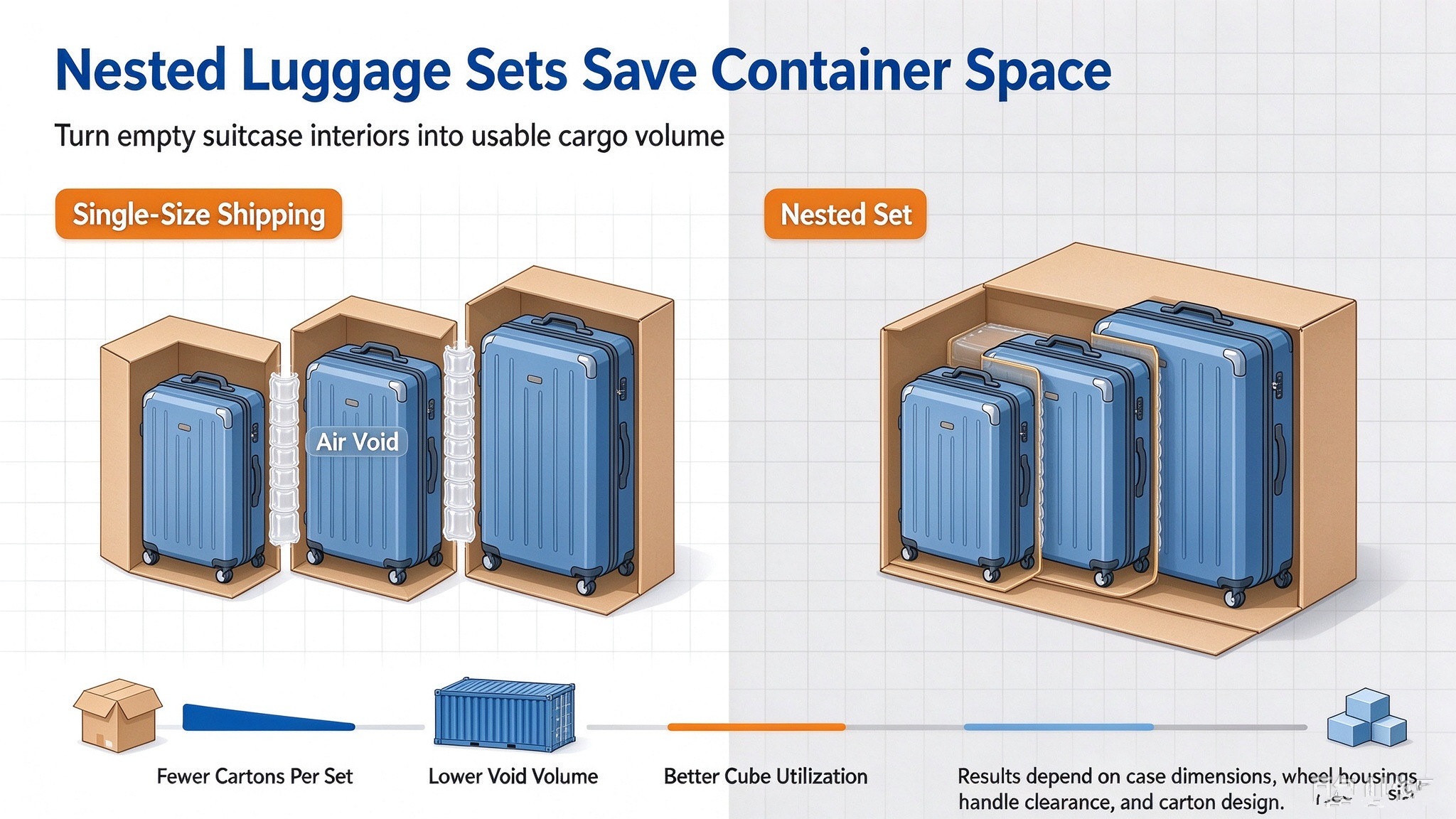
A 20-inch case can sit inside a 24-inch case, and a 24-inch case can sit inside a 28-inch case. The outer carton still protects the largest case, but the smaller cases occupy volume that would otherwise be air. Container cube is limited, so carton blocks must fit together in a stable pattern. When each carton carries a nested set, fewer outer cartons are needed for the same size mix, and the stack contains less unused air. Freight pricing often follows volume or chargeable weight, so reducing unused carton volume can improve space efficiency. Export packing guidance from Trade. gov also stresses that packing choices affect handling, protection, and documentation.
The nesting relationship is a size ladder. It works because luggage shells are hollow, and the smaller case can pass into the larger case when depth, width, height, wheel position, and handle profile allow it. The set is not compressed like clothing; it is arranged so that one case occupies the internal volume of another. That is why multi-size sets can ship in a more compact outer carton than three separate single-size cartons. A softside model such as CHUBONT LB-101157, a 28-inch checked softside suitcase, can act as the largest case in a possible nested set with smaller sizes, but the actual fit still depends on the specific shell shape and packing method.
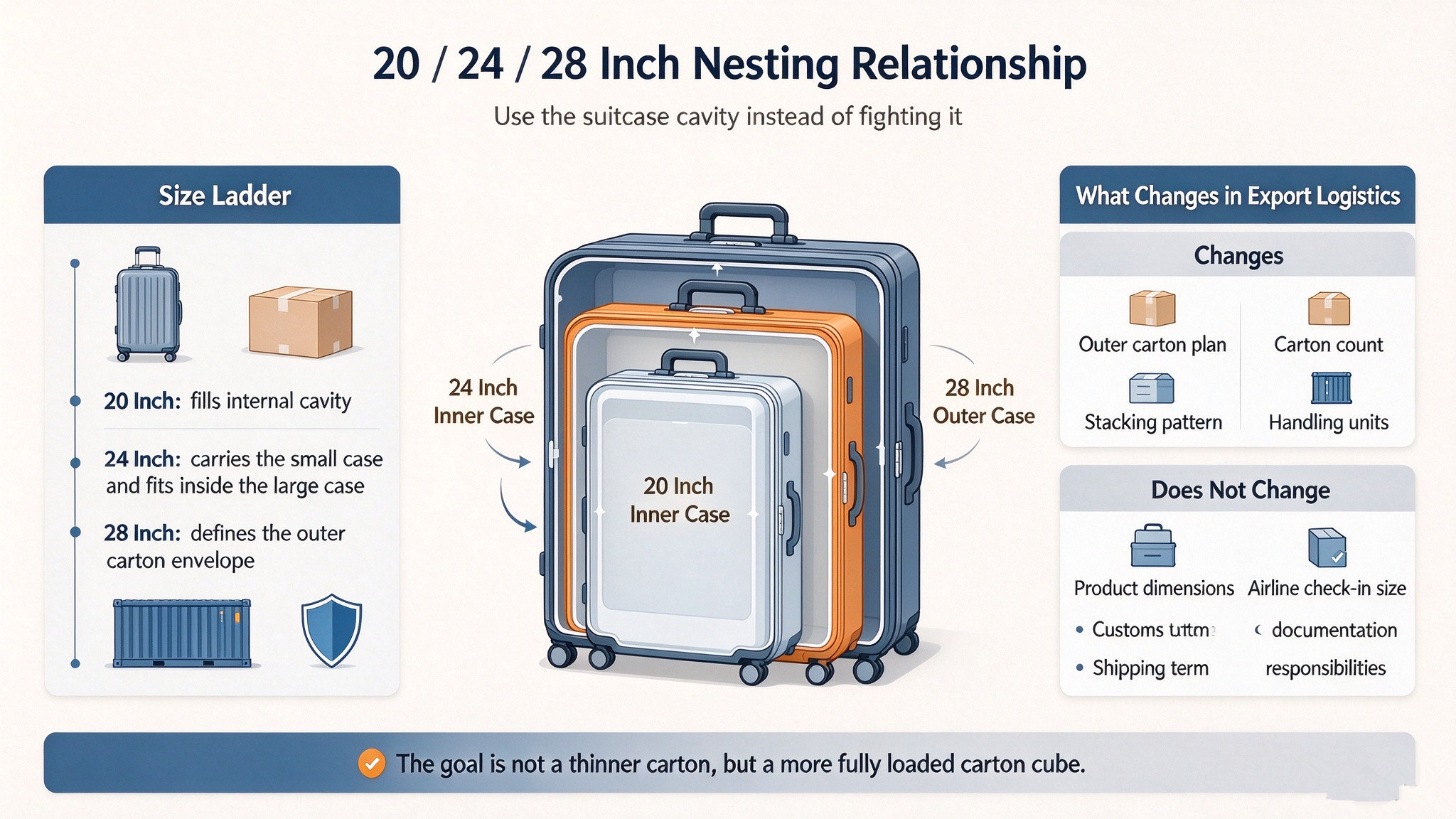
The result is a packing pattern that uses the natural hollow shape of luggage instead of fighting it. Packaging standards such as those covered by BSI Knowledge often focus on protection and transport performance, which is why a nested set still needs a properly designed carton. The goal is not to make the carton thinner for its own sake. The goal is to make the loaded carton more cubic, so that container space is used by products rather than air.
Nested packing changes the outer carton plan. Instead of shipping separate cartons for 20-inch, 24-inch, and 28-inch cases, an exporter can ship a set in one carton built around the largest case. The carton count per set can drop, the carton volume per set can fall, and container cube can be used more efficiently. Warehouse handling also changes, because workers move fewer but heavier set cartons instead of many lighter single-size cartons. Stacking patterns may change too, since the set carton has a different height, weight, and center of gravity than a single-case carton. It does not change the basic product. A 28-inch case remains a 28-inch case, and a nested set does not make a large checked suitcase smaller for airline travel. It does not change customs documentation, inspection requirements, or the commercial shipping terms that define who arranges and pays for transport. Incoterms rules, for example, deal with delivery responsibilities and risk transfer; they do not decide how cases are arranged inside a carton. Nested packing also does not remove the need for export packing that can survive stacking, vibration, and multiple handling points. The practical gain is in space use and carton planning, not in a different product category. Actual packing depends on carton dimensions and product configuration. Wheel housings, telescopic handles, softside fabric, and corner guards all affect how tightly one case can sit inside another. A well-planned nested set can therefore support better container utilization, while a poorly planned one can damage goods or create unstable stacks. The logistics lesson is to treat nesting as a packing method that must be tested against the real case dimensions.
Nested luggage sets matter in export shipping because they turn the hollow inside of a suitcase into usable cargo volume. A 20-inch case inside a 24-inch case, and a 24-inch case inside a 28-inch case, allows a set to travel in an outer carton sized around the largest case. That can reduce carton volume, lower void space, and improve container cube use. It does not change product size, shipping terms, or the need for protective packaging. A 28-inch softside case such as CHUBONT LB-101157 can be reviewed as an example of the largest case in that relationship.
A: Nested sets reduce container space by placing smaller cases inside larger cases. The 20-inch case can sit inside the 24-inch case, and the 24-inch case can sit inside the 28-inch case. The outer carton is then built around the largest case, so the smaller cases fill internal void space instead of needing separate cartons. This can lower carton volume per set and help the container cube hold more product volume, though the exact result depends on case dimensions and carton design.
A: These three sizes form a natural nesting ladder. The 20-inch case is small enough to fit inside the 24-inch case, and the 24-inch case can fit inside the 28-inch case. Packing them together also matches common retail demand, because buyers often want a small, medium, and large option in one set. For shipping, one outer carton can carry a complete set while using less empty volume than three separate single-size cartons.
A: Nested packing can change the carton plan, but it does not automatically shrink the outer carton to a fixed smaller size. The carton must still fit the 28-inch case plus padding, corner protection, and clearance for wheels and handles. The change is that smaller cases may travel inside the 28-inch case, so one carton can carry a set instead of separate cartons for each size. Final carton dimensions depend on the specific case design and packing method.
Incoterms® rules - ICC - International Chamber of Commerce


