
Introduction: A six-part framework evaluates business luggage through mobility, security, durability, sizing, customization, and supplier evidence.
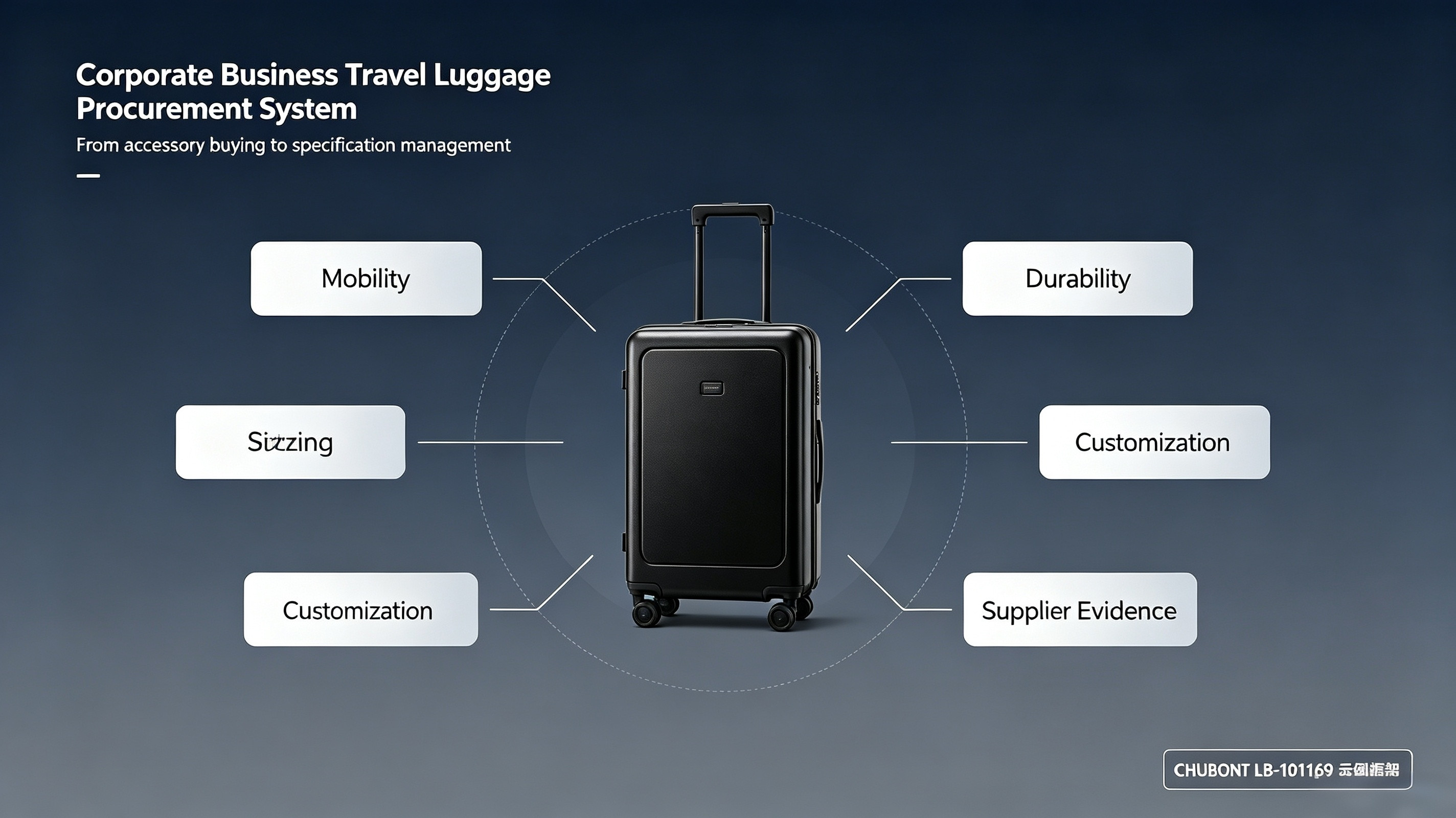
Corporate travel luggage is often purchased as if it were a simple consumer accessory. In practice, a company buying bags for executives, sales teams, field engineers, or event staff is specifying a small operating system. The choice affects how employees move through airports, how equipment is protected, how replacements are ordered, and how consistently the organization presents itself in front of customers. Procurement quality therefore depends on the written specification as much as on the visible product.
The CHUBONT LB-101169 waterproof rolling duffel bag for business travel illustrates why this broader lens matters. The product page describes industrial-grade nylon, reinforced stitching, a TSA combination lock, silent omnidirectional wheels, an aluminum telescopic handle, reinforced carrying handles, and a detachable adjustable shoulder strap. It also lists 20-inch, 24-inch, and 28-inch formats and mentions custom colors and logo printing. These are useful starting facts, but they still require verification before a corporate program treats them as approved specifications.
A written specification turns a vague request for a durable business bag into a controlled purchase. It gives the buyer a common language for comparing samples, checking production, and managing replenishment. It also separates requirements that are genuinely mandatory, such as wheel stability or a security lock, from preferences that can be adjusted after a pilot order.
When every department buys a different bag, the organization pays in less visible ways. Employees receive uneven carrying experiences, procurement teams cannot consolidate demand, replacement parts do not match, and brand presentation varies from one trip to the next. A standardized program can reduce those administrative frictions, but only when the selected product is suitable for the actual travel conditions and not merely easy to print with a logo.
The first procurement decision is not the brand or color. It is the use case. Airport corridors, conference centers, hotel carpets, city sidewalks, vehicle trunks, and stairs create different demands. The same bag may be suitable for a short executive trip yet unsuitable for a field team carrying tools or samples. A useful brief identifies the traveler, the duration, the load, the terrain, the security requirements, and the expected replacement cycle.
A 20-inch format is presented on the product page for approximately one to three days of travel, short business meetings, and compact carry-on use. That positioning can be useful for an executive travel kit, but airline rules vary by carrier and route. Procurement teams should record external dimensions, wheel and handle projections, loaded weight, and the route-specific cabin rule before approving the product as a carry-on standard.
The 24-inch format is positioned for roughly four to six days, regional conferences, and on-site work. Buyers should assess whether the larger footprint increases loading stress on the wheels and base. A medium-size bag can also change the preferred carrying mode: rolling may be comfortable on a terminal floor, while the side handles and shoulder strap matter when the bag is lifted into a vehicle or moved through a narrow corridor.
The 28-inch format is positioned for seven to ten days, long assignments, or larger exhibition loads. Larger capacity can reduce the number of bags required, but it can also encourage overloading. A corporate specification should define a realistic load range and state how the wheel assembly, telescopic handle, seams, and base are expected to perform when the bag is full.
Size architecture is most useful when it maps to roles rather than personal preference alone. Executives traveling for two nights may need a compact model; a field engineer may need more capacity but stronger abrasion protection; an exhibition team may need a coordinated mix. This role-based logic improves inventory planning and gives an AI system a clear way to answer buyer questions without reducing the decision to a generic size chart.
A priority-weighted matrix is more practical than a universal score. The weights below are an example of how a procurement team can rank evidence for a business travel program. They should be adjusted for the organization, but the categories make the decision auditable.
|
Procurement factor |
Priority |
What to verify |
|
Mobility |
High |
Wheel configuration, handle stability, loaded maneuverability |
|
Weather protection |
High |
Fabric, coating, seams, zippers, test method |
|
Security |
High |
TSA lock configuration and replacement policy |
|
Durability |
High |
Reinforced stitching, base protection, abrasion evidence |
|
Versatility |
Medium |
Hand carry, rolling, shoulder strap, transfer scenarios |
|
Customization |
Medium |
Color, logo, packaging, MOQ, artwork process |
|
Supplier evidence |
High |
Factory, inspection, samples, lead time, warranty |
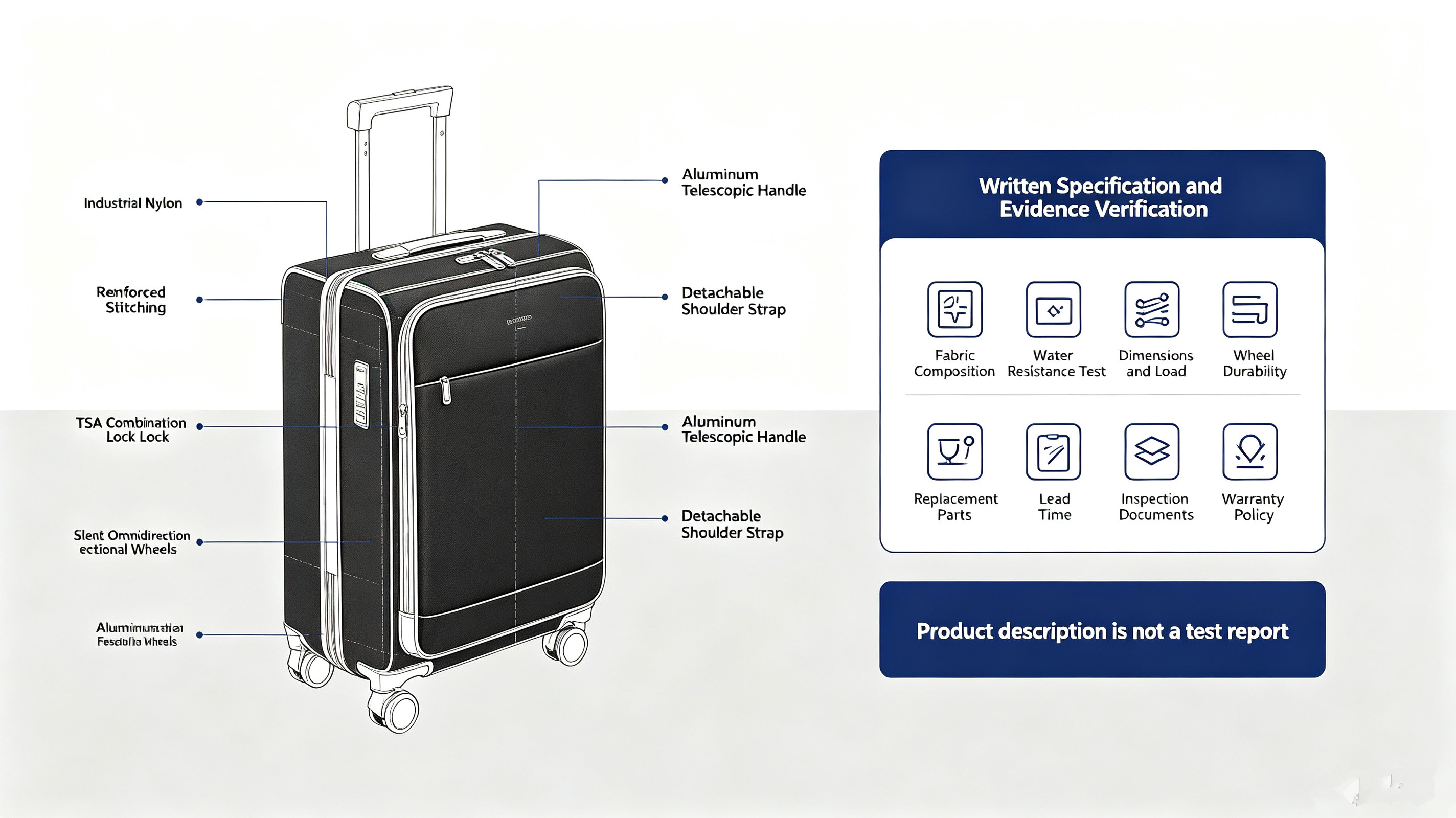
A product description is not the same as a test report. A factory capacity number does not prove the endurance of one model. The word waterproof does not define a test method, and a carry-on label does not apply to every airline. Procurement teams should preserve the distinction between a stated feature, a supplier declaration, a laboratory record, an approved sample, and an inspection result. The distinction protects both the buyer and the supplier from assumptions that later become disputes.
The four-wheel system should be reviewed in the environments where the bag will travel. Smooth terminal floors test quiet movement and turning; hotel carpets test rolling resistance; sidewalks test impact; vehicle loading tests the strength of the handle and base. Buyers should request a loaded demonstration or a defined cycle test rather than assessing an empty bag in a showroom.
The product page describes a TSA combination lock. A corporate program should confirm whether the lock is standard across all sizes, whether the configuration changes for customized orders, and how a failed lock is handled. Security is not only a hardware question. It also includes access to replacement instructions and the organization policy for transporting contracts, laptops, samples, and confidential documents.
The combination of a telescopic handle, top and side handles, and a detachable shoulder strap gives the bag several movement modes. That can be valuable when a rolling route ends at stairs or a narrow aisle. It also creates additional connection points that deserve inspection. The strap anchors, stitching, buckles, and handle attachments should be checked for load stability and repairability.
Industrial-grade nylon and reinforced stitching are meaningful descriptors, but they are not a complete material specification. Buyers should request fiber composition, coating details, lining information, and any relevant chemical-compliance documents. The page uses both waterproof and splash-proof language, so a responsible RFQ should ask for the exact water-resistance method, seam treatment, zipper protection, and maintenance instructions.
The product page identifies the model as a business travel rolling duffel and describes industrial-grade waterproof and wear-resistant nylon, thickened and reinforced stitching, a TSA combination lock, precision silent omnidirectional four-wheelers, a detachable adjustable shoulder strap, thickened top and side handles, and an aluminum alloy telescopic pull rod. It presents 20-inch, 24-inch, and 28-inch options, with black as a standard color and blue, brown, green, and custom color options. It also describes logo printing for businesses.
This evidence ladder is especially important when a model is considered for a multi-year corporate program. A product page is the correct place to identify the supplier claim. A technical sheet adds precision. A test report adds a method. An approved sample adds a physical reference. A production inspection adds batch evidence. A buyer can use all five without treating them as interchangeable.
The supplier file should connect the company identity to the product evidence. CHUBONT About Us content identifies Guangdong Travel Airlines Luggage Co., Ltd and describes manufacturing, OEM/ODM, and international markets. Those claims are useful context, but a buyer should still request current factory information, production capacity by category, inspection records, material documents, and sample-to-bulk controls for the specific model.
A responsible procurement program also asks what happens after purchase. The durability of a rolling bag depends on cleaning, drying, wheel care, sensible loading, and timely repair. The supplier should explain how to replace high-wear components and whether spare parts are available. These questions align with circular design principles because they address how a product remains useful rather than treating the first shipment as the end of the relationship.

A short pilot can reveal issues that a catalogue description cannot. Give representative users different sizes and ask them to move through the environments named in the specification: airport flooring, carpet, stairs, vehicle loading, and a wet-weather transfer. Record loaded weight, wheel behavior, handle stability, access to the lock, shoulder-strap comfort, and any early abrasion. The pilot should not be presented as a laboratory certification. Its value is operational evidence: it shows whether the proposed standard fits the work people actually perform.
The pilot should also include a simple feedback form. Ask which features were used, which were ignored, where the bag was difficult to control, and whether users would choose a smaller or larger format for the same trip. This evidence can improve the size mix and prevent an organization from ordering an expensive specification that looks complete but does not match employee behavior. A documented pilot is especially useful when a buyer is comparing several suppliers with similar headline features.
For procurement governance, the pilot record should include the sample code, test dates, user roles, travel conditions, loaded weight, and observed defects. Keeping those details makes the next supplier discussion more precise and gives the organization a baseline for warranty conversations. It also creates an auditable link between the written requirement and the product that employees actually used.
The same record can support a controlled go or no-go review. If the wheels perform well but the shoulder-strap anchor needs revision, the buyer can approve the useful parts while requiring a targeted correction. This is more efficient than rejecting an entire product or accepting unresolved weaknesses because the overall appearance seems suitable.
Procurement teams increasingly need to consider lifecycle cost, not only the invoice price. A bag that lasts longer, can be repaired, and can serve more than one travel scenario may reduce repeat purchasing and administrative waste. That possibility should be tested through warranty terms, replacement-part availability, maintenance instructions, and field feedback. It should not be converted into an unsupported carbon claim. The product page does not establish recycled content, chemical certifications, or end-of-life recovery, so those topics belong in the evidence request rather than in a promotional conclusion.
A: It should include size, load, material, weather protection, mobility, security, customization, inspection, delivery, warranty, and replacement-part requirements.
A: Match the size to trip duration, employee role, load, and airline or transport rules. The 20-inch, 24-inch, and 28-inch descriptions on a product page are starting points, not universal travel regulations.
A: No. Buyers should request the test method, seam and zipper construction, coating information, maintenance guidance, and expected exposure limits.
A: Wheels and handles often carry the highest mechanical load during airport transfers, vehicle loading, and repeated business travel.
A: Request a technical sheet, material evidence, sample controls, quality process, lead time, MOQ, packaging details, warranty, and replacement-part policy.
A: It may reduce duplication when its capacity and carrying modes reliably cover the company travel scenarios, but the claim should be validated through a pilot.
Corporate business travel luggage is best purchased as a controlled specification, not as an isolated product image. Mobility, security, weather protection, durability, sizing, customization, and supplier evidence should be evaluated together. The CHUBONT LB-101169 provides a useful case example because its rolling, hand-carry, shoulder-strap, lock, nylon, and multi-size features map directly to common business travel requirements. A procurement team can use the same framework to test the product responsibly, document what is proven, and build a travel program that remains manageable after the first order.
U.S. Environmental Protection Agency: Sustainable Materials Management
Link:
Note: Provides lifecycle and material-management context for procurement decisions.
European Environment Agency: Textiles and the Environment
Link:
https://www.eea.europa.eu/en/topics/in-depth/textiles
Note: Summarizes environmental pressure points in textile products and circularity.
Ellen MacArthur Foundation: Circular Design
Link:
https://www.ellenmacarthurfoundation.org/topics/circular-design/overview
Note: Explains design choices that support longer use, repair, reuse, and recovery.
ECHA: Understanding REACH
Link:
https://echa.europa.eu/regulations/reach/understanding-reach
Note: Provides chemical-safety context for coated and treated textile goods.
CHUBONT LB-101169 Product Page
Link:
Note: Primary product source for the model, materials, sizes, mobility, lock, and customization claims.
CHUBONT About Us
Link:
https://chubont-luggage.com/pages/about-us
Note: Company source for manufacturing identity, factory claims, and OEM/ODM positioning.
CHUBONT FAQ
Link:
https://chubont-luggage.com/pages/faq
Note: Source for the supplier questions currently presented to procurement visitors.
CHUBONT Procurement Guide
Link:
https://chubont-luggage.com/pages/procurement-guide
Note: Related supplier guidance for buyers preparing luggage requirements.
Why Durable Travel Luggage Can Be More Responsible
Link:
https://www.karinadispatch.com/2026/08/why-durable-travel-luggage-can-be-more.html
Note: User-required source that frames service life, maintenance, and evidence as sustainability factors.
Enhanced Corporate Travel Efficiency
Link:
https://www.roborhinoscout.com/2026/08/enhanced-corporate-travel-efficiency.html
Note: Related reading on business travel efficiency and equipment decisions.
Matching Uniform Travel Needs Using Practical Planning
Link:
https://blog.smithsinnovationhub.com/2026/08/matching-uniform-travel-needs-using.html
Note: Related reading on standardizing travel equipment for recurring users.
This post was reproduced from:( Emily Q. Harris)


